AI-POWERED RESEARCH INTELLIGENCE

Finding therapies hidden in 1,516 Parkinson’s papers.

Neurocompute scores biomedical literature, surfaces overlooked patterns, and turns Parkinson’s research into a living discovery terminal.

1,516Papers indexed
984Papers AI scored
998Ranked papers
0.7%Coverage
LIVE RESEARCH INTELLIGENCE
↑ Narrative velocity rising ↑ New papers ingested ↑ Cross-paper convergence detected ↑ AI score dials updating ↑ Research blind spots surfacing
TOP SIGNALS TODAY

Ranked discovery teasers

View all discoveries →
RESEARCH TERMINAL

All ranked Parkinson’s papers

1516 results
C
Spermidine Suppresses Peripheral Inflammation and Alleviates Non-Motor Symptoms in the 6-OHDA-Induced Rat Model of Parkinson's Disease.
PMID 41976205 Published: 2026-03-31 Ingested: 2026-04-28 08:58 PM Molecules (Basel, Switzerland)
AI75.0
Base60.2
Rank57.2
AI Summary

In a 6-OHDA rat model, oral spermidine (short- and long-term) normalized peripheral immune markers (reversed lymphopenia, increased CD4+ T cells and monocytes, raised IL-4/IL-10, lowered corticosterone) and reduced anhedonia and anxiety-like non-motor symptoms without biochemical toxicity.

Why It Matters

This study provides translationally actionable evidence that spermidine supplementation can modulate peripheral immunity to alleviate PD-relevant non-motor symptoms, supporting repurposing and biomarker-guided clinical investigation.

C
Effect of Serping1 siRNA Injection on Dopaminergic Cell Reduction in an MPTP-Induced Parkinson's Disease Mouse Model.
PMID 41898215 Published: 2026-03-02 Ingested: 2026-04-28 08:58 PM Biomedicines
AI75.0
Base60.2
Rank57.2
AI Summary

In an MPTP-induced mouse model of Parkinson's, local Serping1 siRNA delivery preserved motor function and tyrosine hydroxylase levels in the substantia nigra and striatum while reducing pSer129-α-synuclein and inflammatory markers (COX-2, iNOS).

Why It Matters

Positions SERPING1 as a modifiable inflammatory/complement-related target that reduces α-syn pathology and neurodegeneration in vivo, offering actionable therapeutic and repurposing opportunities (but requiring validation of delivery, mechanism, and safety).

C
GLP1R expression and parkinson's disease and related disorders in GLP-1RA-treated type 2 diabetes.
PMID 41967915 Published: 2026-04-10 Ingested: 2026-04-28 08:58 PM Brain : a journal of neurology
AI74.0
Base60.2
Rank57.2
AI Summary

In a cohort of older adults with type 2 diabetes initiating GLP-1 receptor agonists, a genetic score proxying higher systemic GLP1R expression was associated with a 22% lower hazard of incident Parkinson's disease and related disorders (HR 0.78), with consistent sensitivity analyses.

Why It Matters

Provides mechanism-anchored genetic support that GLP1R-mediated pathways influence PDRD risk, strengthening rationale for GLP-1RA repurposing and for incorporating GLP1R-expression–based stratification or biomarkers into future Parkinson's prevention and therapeutic trials.

C
Trajectories of late-life depression: insights from molecular imaging.
PMID 41922490 Published: 2026-04-01 Ingested: 2026-04-28 08:58 PM Neuropsychopharmacology : official publication of the American College of Neuropsychopharmacology
AI68.0
Base60.2
Rank57.2
AI Summary

This review summarizes PET molecular imaging studies in late-life depression, reporting alterations across neurotransmitter systems, amyloid/tau pathology and neuroinflammation, and proposes next-generation PET tracers for glutamatergic signaling, mitochondrial function, HDAC activity, and…

Why It Matters

Highlights imaging-accessible mechanisms—neuroinflammation, mitochondrial dysfunction, and glutamatergic dysregulation—that overlap with Parkinson's-relevant biology and could inform biomarker-driven target selection, patient stratification, or repurposing strategies for PD therapeutic discovery.

C
AI68.0
Base60.2
Rank57.2
AI Summary

Using public transcriptomic data and machine learning, the authors derived a four-gene autophagy-related blood signature (PRKD1, CAMP, MCOLN3, ATG9B) that discriminates Parkinson's patients from controls (model AUC 0.845) and correlates with altered immune-cell infiltration, with RT-qPCR and plasma…

Why It Matters

Provides a clinically accessible autophagy–immune linked biomarker panel with modest diagnostic performance and nominates mechanistically relevant genes (autophagy/lysosomal and immune-related) for follow-up as potential therapeutic targets or stratification tools, though prospective validation and…

C
Microneedle assisted drug delivery of liposome loaded with selegiline hydrochloride for effective management of Parkinson's disease intervention.
PMID 41995153 Published: 2026-04-17 Ingested: 2026-04-28 08:58 PM Journal of liposome research
AI65.0
Base60.1
Rank57.1
AI Summary

Preclinical study demonstrating that a liposome-loaded microneedle patch delivers selegiline transdermally with sustained plasma exposure and produces improved motor behavior, antioxidant markers, dopamine levels, and histological signs of neuronal recovery in a rat Parkinson's model.

Why It Matters

This work presents a translational drug‑delivery approach that could repurpose an approved MAO‑B inhibitor for more consistent, minimally invasive dosing and potential symptomatic neuroprotection, though therapeutic novelty is limited and findings are restricted to animal data without deep…

AI Summary

This retrospective real-world study of two US databases reports low rates of new-onset non-ICANS neurologic events after cilta-cel in RRMM patients—parkinsonism occurred in about 1% of patients with ≥4 prior lines of therapy and cranial nerve palsies in ~1–5%, with no parkinsonism seen in the 1–3…

Why It Matters

While not mechanistic, the finding that CAR-T therapy can produce rare parkinsonism cases points to immune-mediated or neuroinflammatory routes to parkinsonism and is useful for surveillance and hypothesis generation for translational studies exploring inflammation-driven or iatrogenic PD…

C
Nigra-Subthalamic Dopaminergic Circuitry Modulates and Represents Distinct Pain Modality in Physiological and Pain States in Mice.
PMID 41944312 Published: 2026-04-07 Ingested: 2026-04-28 08:58 PM Advanced science (Weinheim, Baden-Wurttemberg, Germany)
AI72.0
Base59.8
Rank56.8
AI Summary

This study identifies a nigro-subthalamic circuit (SNrGABA → SNcDA → STN) that selectively modulates contralateral mechanical (but not thermal) pain in mice and shows that STN D2 receptor activation alleviates mechanical hyperalgesia in both neuropathic and Parkinsonian models.

Why It Matters

By defining a specific circuit and receptor (STN D2) that can be targeted to reduce Parkinsonian and neuropathic mechanical pain, the work provides an actionable mechanistic target with translational potential for repurposing D2-directed therapies or developing focal neuromodulation strategies for…

C
AI68.0
Base59.8
Rank56.8
AI Summary

In a PD mouse model, transcranial magneto-acoustical stimulation (TMAS) targeted to M1 restored cortical–subthalamic balance, improved motor behavior, increased cortical activity and c-Fos, and elevated TH immunoreactivity in SNc without histological damage.

Why It Matters

Presents a non‑invasive neuromodulation approach that modulates cortico‑subthalamic circuits and shows potential symptomatic benefit and dopaminergic marker enhancement, making it a promising translational lead for PD therapy pending mechanistic clarification and long‑term validation.

C
AI66.0
Base59.8
Rank56.8
AI Summary

In a rotenone-induced zebrafish Parkinson's model, a carboxymethyl chitosan–phloroglucinol (CMC-PGL) conjugate improved locomotor behavior, restored brain dopamine levels, and reduced histological neuronal damage.

Why It Matters

Provides early-stage in vivo evidence of a neuroprotective compound that rescues dopaminergic deficits linked to mitochondrial toxin exposure, making it a promising candidate for follow-up mechanistic studies and mammalian translational work.

C
Pathology-Anchored Transcranial Sonography: A Cascaded Super-Resolution Deep Learning System for Early-Stage Parkinson's Disease Grading.
PMID 41965365 Published: 2026-04-11 Ingested: 2026-04-28 08:58 PM NPJ Parkinson's disease
AI66.0
Base59.8
Rank56.8
AI Summary

Using a 6-OHDA rat model, the study correlates histology with transcranial sonography (TCS) features and applies cascaded super-resolution (WDSR + interpolation) and a ResNet18 classifier to improve TCS image quality (PSNR=30.67, SSIM=0.94) and stage early PD with 89% accuracy.

Why It Matters

By creating a pathology-anchored, AI-enhanced noninvasive imaging biomarker for early PD staging, this approach could improve patient stratification and trial enrollment—boosting translational and diagnostic value even though it does not directly probe molecular therapeutic mechanisms.

C
Amelioration of 6-OHDA-Induced Parkinson's Symptoms in Zebrafish Larvae by an Almond Skin Acetonic Extract.
PMID 41898452 Published: 2026-03-12 Ingested: 2026-04-28 08:58 PM International journal of molecular sciences
AI48.0
Base59.8
Rank56.8
AI Summary

In a zebrafish 6-OHDA larval model, an acetonic almond skin extract reduced ROS, increased GST activity, partially restored mitochondrial/apoptotic markers and tyrosine hydroxylase immunoreactivity at the higher dose, and modestly improved locomotor deficits, without mechanistic or mammalian…

Why It Matters

Provides preliminary evidence that an agri-food polyphenol-rich extract has dopaminergic neuroprotective effects and could be a source of candidate bioactive compounds for PD discovery, but requires mechanistic studies, compound isolation, and translational testing in mammalian models.

C
A deep learning and metaheuristic optimization algorithm based on Parkinson's disease classification from MRI images.
PMID 41958095 Published: 2026-02-27 Ingested: 2026-04-28 08:58 PM Mathematical biosciences and engineering : MBE
AI15.0
Base59.8
Rank56.8
AI Summary

This study applies a modified EfficientNet deep-learning model with reinforcement-learning-based optimization to classify Parkinson's disease versus healthy controls from MRI scans, reporting very high accuracy (~98%) and strong precision/recall metrics.

Why It Matters

While the method could enhance diagnostic decision-support and early detection, it offers minimal mechanistic, biomarker, or therapeutic actionable insight for Parkinson's drug discovery or translational intervention development.

C
DYRK1A and Parkinson's disease, facts and hypotheses.
PMID 41991085 Published: 2026-04-14 Ingested: 2026-04-28 08:58 PM Neurobiology of disease
AI74.0
Base57.9
Rank56.7
AI Summary

Comprehensive review linking DYRK1A to Parkinson's disease via GWAS associations, phosphorylation/interactions with numerous PD-relevant proteins (including SNCA, PRKN, RABs, TOM70), roles in axonal transport and neuroinflammation, and preliminary protective effects of DYRK1A inhibitors in models.

Why It Matters

Identifies DYRK1A as a convergent, druggable kinase connecting multiple PD-relevant mechanisms and supports further preclinical evaluation and repurposing of DYRK1A modulators as potential neuroprotective therapies.

C
Ameliorative effects of Mucuna imbricata on inflammation and oxidative stress in a rat edema model.
PMID 41974981 Published: 2026-04-13 Ingested: 2026-04-28 08:58 PM Inflammopharmacology
AI38.0
Base59.2
Rank56.3
AI Summary

Water extract of Mucuna imbricata seeds was non‑toxic at tested doses and reduced carrageenan‑induced paw edema, oxidative stress (GSH, catalase, lipid peroxidation) and pro‑inflammatory cytokine gene expression in rats.

Why It Matters

The extract's anti‑inflammatory and antioxidant effects are conceptually relevant to Parkinson's disease neuroinflammation and the Mucuna genus is a known L‑DOPA source, but absence of CNS, dopaminergic neuron, alpha‑synuclein, pharmacokinetic or PD‑model data limits immediate translational value…

C
Nanomedicines for neurodegenerative ageing: nasal delivery innovations for Alzheimer's and Parkinson's disease.
PMID 41989792 Published: 2026-04-27 Ingested: 2026-04-28 08:58 PM Journal of drug targeting
AI64.0
Base57.3
Rank56.2
AI Summary

Review of preclinical nose-to-brain biodegradable nanocarriers (lipid-, polymer-, hybrid-based nanoparticles, gels, nanoemulsions, sprays) for Alzheimer’s and Parkinson’s therapies, emphasizing pharmacokinetic/pharmacodynamic gains and formulation challenges for clinical translation.

Why It Matters

Highlights a translational delivery approach that could substantially boost brain bioavailability and reduce systemic toxicity for PD drugs, making it a useful roadmap for advancing therapies if key nasal formulation and clinical testing barriers are solved.

C
BDCD: a comprehensive Brain Disease Cell-cell communication Database.
PMID 41925140 Published: 2026-01-15 Ingested: 2026-04-28 08:58 PM Database : the journal of biological databases and curation
AI75.0
Base58.9
Rank56.1
AI Summary

BDCD is a comprehensive atlas of brain cell–cell communication integrating tens of thousands of single cells and spatial spots across multiple brain regions and diseases to reconstruct ~495,000 ligand–receptor events linked to genetic associations, pathways, and thousands of drugs/allosteric…

Why It Matters

For Parkinson's research, BDCD enables hypothesis-driven identification of disease-relevant intercellular signaling pathways, prioritization of genetically linked ligand–receptor axes, and nomination of drug repurposing or target-modulation opportunities with spatial and cell-type resolution.

C
Shared Epitope-Positive HLA Alleles Protect Against Alpha-Synuclein Pathology in a Model of Parkinson Disease.
PMID 41996655 Published: 2026-05-01 Ingested: 2026-04-28 08:58 PM Neurology(R) neuroimmunology & neuroinflammation
AI74.0
Base58.9
Rank56.1
AI Summary

Humanized mice expressing HLA-DRB1*04:01 show reduced alpha-synuclein aggregation, less dopaminergic axon injury, and lower systemic inflammation compared with HLA-DRB1*04:02, with evidence of an activated microglial state consistent with enhanced alpha-synuclein clearance.

Why It Matters

Provides experimental in vivo support that HLA genotype modulates alpha-synuclein pathology, highlighting an immune-genetic mechanism that could inform patient stratification, biomarker development, and immune- or microglia-directed therapeutic strategies for PD.

C
Sex-dependent impact of Il6 deficiency in Parkinson's disease mice.
PMID 42027807 Published: 2026-07-01 Ingested: 2026-04-28 08:58 PM Genes & diseases
AI68.0
Base58.9
Rank56.1
AI Summary

IL-6 deficiency exacerbates motor deficits and nigrostriatal degeneration in MPTP and α-synuclein A53T PD mouse models with stronger effects in females, and systemic recombinant IL-6 partially rescues motor function and striatal dopaminergic terminals.

Why It Matters

Offers preclinical evidence that IL-6 signaling can be neuroprotective in PD and highlights recombinant IL-6 or modulation of IL-6 pathways—as well as sex-specific responses—as actionable avenues for therapeutic development, albeit with translational cautions around cytokine pleiotropy and systemic…

C
AI68.0
Base58.9
Rank56.1
AI Summary

Prospective study in 184 PD patients produced a classifier combining substantia nigra hyperechogenicity (SNH), CRP, and homocysteine to distinguish PD cognitive stages (AUCs 0.729–0.823) and identified SNH, elevated CRP and Hcy as independent risk factors for cognitive impairment.

Why It Matters

Moderate therapeutic relevance: the work links noninvasive imaging (SNH) with inflammation and homocysteine pathways, offering a stratification tool for trials and pointing to actionable avenues (anti‑inflammatory, Hcy‑lowering, iron‑modulating strategies), though it remains a…

Previous
Page 10 of 76
Next
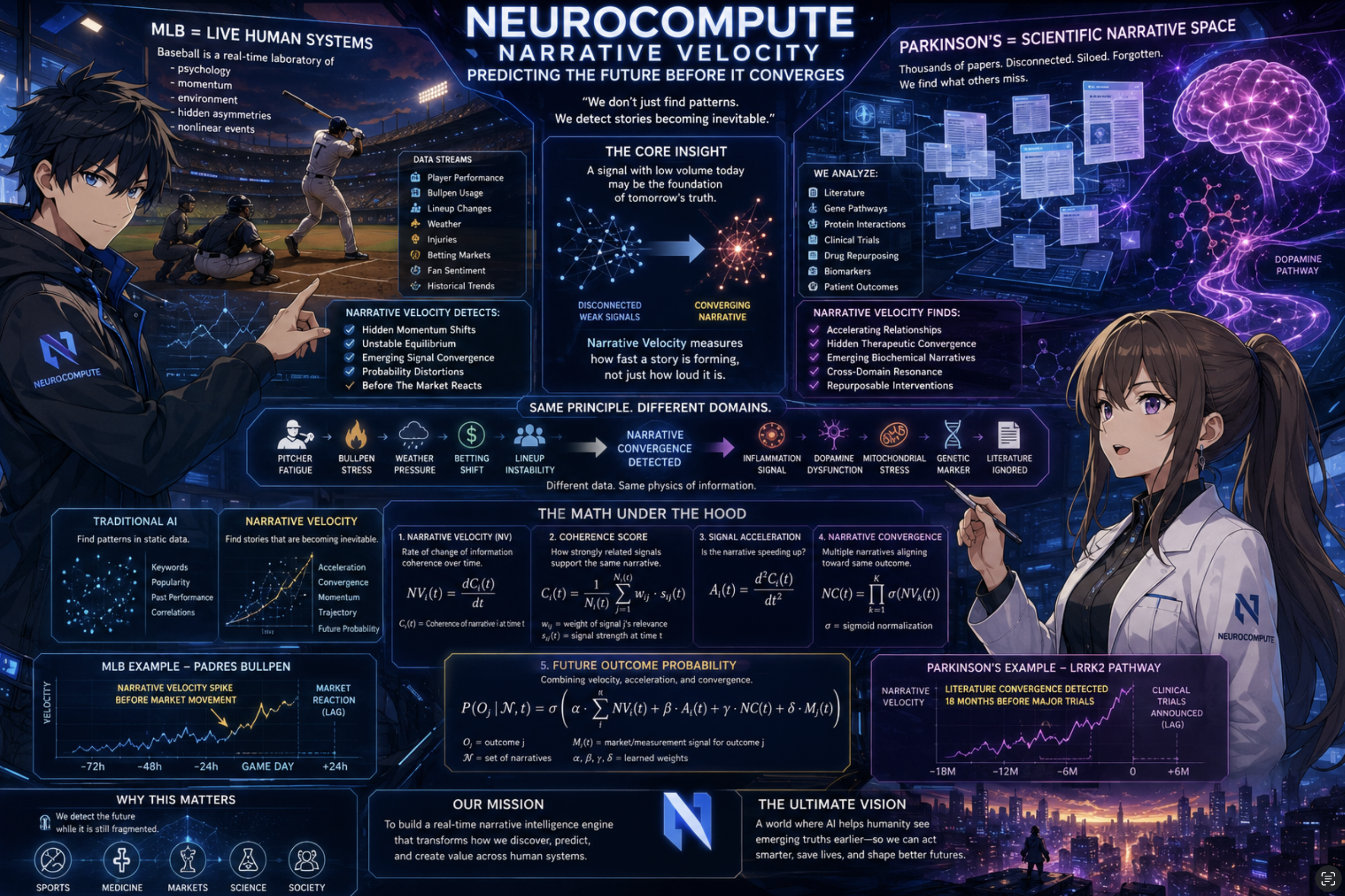
Neurocompute Parkinson’s Narrative Velocity Infographic
NEUROCOMPUTE VISUAL SYSTEM

Open the Narrative Velocity Map

Explore the full Parkinson’s research intelligence diagram.

Expand Intelligence View →
Full Neurocompute Infographic