A grade · PMID 41966779
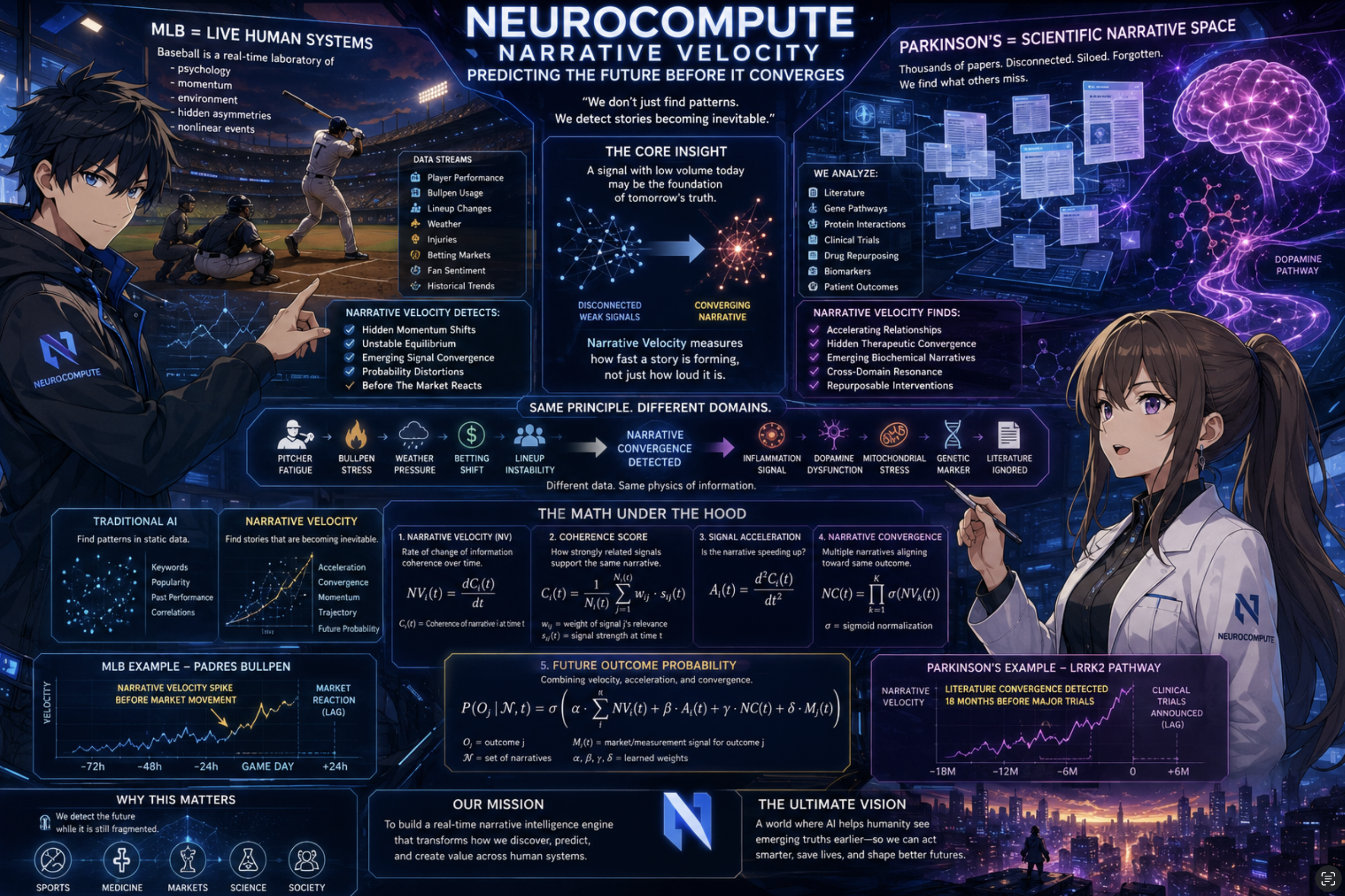
View analysis →Finding therapies hidden in 1,516 Parkinson’s papers.
Neurocompute scores biomedical literature, surfaces overlooked patterns, and turns Parkinson’s research into a living discovery terminal.
Ranked discovery teasers
B grade · PMID 42041525
View analysis →B grade · PMID 42038302
View analysis →B grade · PMID 42042751
View analysis →B grade · PMID 41900432
View analysis →B grade · PMID 41947971
View analysis →B grade · PMID 41895375
View analysis →B grade · PMID 41922384
View analysis →B grade · PMID 41903861
View analysis →B grade · PMID 41993915
View analysis →Database feed
All ranked Parkinson’s papers
This review posits a testable 'vicious triad' in PD where gut-derived triggers, cGAS‑STING–driven neuroinflammation, and astrocyte/glymphatic clearance failure form a self‑amplifying loop and proposes combinatorial interventions (microbiome engineering, STING antagonists, astrocyte modulation,…
By synthesizing gut-brain, innate immune (cGAS‑STING), and clearance (glymphatic/AQP4) biology into an actionable, biomarker-friendly model, the paper highlights multiple tractable targets and rational combinatorial strategies with clear translational and repurposing potential for disease‑modifying…
This review synthesizes evidence that immunosenescence and chronic inflammaging drive neurodegeneration by disrupting microglial and astrocyte homeostasis, mitochondrial and barrier function, and protein-aggregate clearance, and it surveys actionable therapeutic strategies—senolytics,…
Directly relevant to Parkinson's therapeutic discovery because it links immune-aging mechanisms (senescent glia, systemic inflammation, BBB dysfunction) to impaired clearance of protein aggregates (e.g., α‑synuclein) and prioritizes clinically translatable interventions and delivery approaches that…
This review synthesizes preclinical evidence that diverse flavonoids (e.g., baicalein, quercetin, apigenin, luteolin, EGCG) provide multi-target neuroprotection in PD by modulating dopamine, serotonin, glutamate and acetylcholine systems and by impacting α‑synuclein pathology, mitochondrial…
By naming specific flavonoid candidates, summarizing mechanisms relevant to key PD pathways and outlining translational barriers (BBB penetration, formulation, safety), the paper serves as a practical roadmap for drug-discovery teams seeking multi-target or repurposing strategies for Parkinson’s…
Narrative review showing that alpha‑lipoic acid and biotin converge on mitochondrial, redox, and inflammatory pathways with consistent preclinical benefit but heterogeneous and limited clinical evidence across neurodegenerative diseases.
Provides a rationale for repurposing alpha‑lipoic acid (and to a lesser extent biotin) in Parkinson's disease based on mitochondrial and antioxidant mechanisms and safety profile, while highlighting the need for well‑designed PD‑specific clinical trials to establish dosing and efficacy.
Narrative review integrating clinical, metagenomic, metabolomic and mechanistic data that links PD-associated gut dysbiosis (reduced SCFAs, pro-inflammatory metabolic shifts, barrier dysfunction) to intestinal immune activation, α-synuclein aggregation and neuroinflammation, framing the gut…
Identifies actionable upstream mechanisms—microbial metabolites, gut barrier and immune signaling—that offer paths for disease-modifying interventions, biomarkers, and translational repurposing in Parkinson's research.
Comprehensive review linking TLR2-driven chronic inflammation and metabolic dysfunction in type 2 diabetes to neuroinflammation, mitochondrial and BBB pathology, and outlining therapeutic strategies (drugs, supplements, and antidiabetic repurposing) that could mitigate diabetes-associated…
TLR2 maps a mechanistic bridge between systemic metabolic inflammation and brain pathology (microglial activation, mitochondrial dysfunction, BBB disruption), offering actionable targets and repurposing opportunities relevant to Parkinson's-related neuroinflammatory and metabolic pathways despite…
In an acute MPTP mouse model, a GLP-2 analogue and a GLP-2/GIP dual agonist improved motor performance and reduced α‑synuclein accumulation, neuroinflammation (TNF‑α, NF‑κB) and apoptosis (↓Bax, ↑Bcl‑2), with the dual agonist showing superior effects.
Provides preclinical evidence that GLP-2/GIP receptor co-agonism can modulate key PD-relevant mechanisms (inflammation, α‑synuclein, apoptosis), supporting further translational work (chronic models, mechanism dissection, PK/safety) toward a potential disease-modifying therapy.
TNFα promotes α-synuclein accumulation and impairs the malate–aspartate shuttle in patient iPSC-derived enteric neurons, driving a shift to glutamine oxidation, mitochondrial dysfunction that is partly rescued by Chicago-Sky-Blue 6B, and mirroring inflammation-associated metabolic and α-syn changes…
The study pinpoints a druggable metabolic vulnerability (malate–aspartate shuttle dysfunction) and an inflammatory driver (TNFα) in enteric neurons, demonstrates partial pharmacologic rescue, and provides a patient-derived platform that directly supports gut‑brain–targeted PD therapeutic discovery…
This review links disrupted lipid metabolism—altered cholesterol trafficking, sphingolipid/ceramide pathways, and phospholipid remodeling—to neuroinflammation and cell-type–specific metabolic shifts that increase neuronal vulnerability, and it outlines therapeutic approaches (ApoE modulation,…
Provides actionable, translational targets and biomarker strategies tied to inflammation and membrane/lysosomal-related vulnerability that are directly relevant to Parkinson’s therapeutic discovery, despite being a review rather than new primary data.
Shotgun metagenomics of stool from PD patients, controls, and IBS-C showed taxonomic differences but conserved functional deficits in PD—notably reduced microbial tryptophan biosynthesis, polyamine production, and B‑vitamin metabolism—while constipated PD patients trended toward higher circulating…
Identifies specific microbial metabolic pathways linked to neurotransmitter production, epithelial integrity, and neuroimmune regulation that are actionable targets for microbiome‑based, dietary, or supplementation interventions in PD-related GI dysfunction and possibly…
This broad review highlights benzimidazole as a versatile medicinal chemistry scaffold with preclinical MAO-B inhibitors, dopamine receptor modulators, and NMDA antagonists and reports favourable ADMET/BBB properties, but provides limited PD-specific in vivo or clinical evidence.
For Parkinson’s drug discovery, benzimidazole derivatives offer actionable repurposing and multi-target opportunities (MAO-B inhibition, dopaminergic modulation, anti-excitotoxic and anti-aggregation strategies) that warrant focused in vivo PD studies and optimization toward clinical candidates.
This preclinical study shows polydopamine nanoparticles (synthetic neuromelanin) protect dopaminergic neurons in 6-OHDA Parkinson's models by scavenging ROS, normalizing iron metabolism, inhibiting ferroptosis, reducing microglial activation, and rescuing motor/gait deficits.
Provides a mechanistically grounded, multi-target nanoparticle therapy that addresses oxidative stress, iron dysregulation and ferroptosis—key PD pathways—and demonstrates in vivo behavioral and neuroprotective efficacy, supporting translational potential.
This review synthesizes evidence that klotho exerts broad neuroprotective effects—reducing oxidative stress and neuroinflammation, stabilizing synapses, supporting myelination and proteostatic clearance—and outlines therapeutic approaches (recombinant protein, gene therapy, small molecules,…
Klotho represents a translationally actionable neuroprotective target with multiple intervention modalities and clinical biomarker correlations relevant to slowing neurodegeneration and cognitive decline in Parkinson's disease, though PD-specific mechanistic data and blood–brain barrier delivery…
In a 6-OHDA rat model of Parkinson's disease, oral rutin (10 mg/kg for 14 days) reduced intestinal inflammation—decreasing intraepithelial lymphocytes, goblet cell changes, and ileal Paneth cell hyperplasia—while selected gut bacterial taxa measured by PCR were unchanged.
This supports the idea that a dietary flavonoid can attenuate PD-related enteric inflammation and thus could be a candidate for gut-targeted adjunctive therapies influencing the gut-brain axis, though the study lacks central neuroprotection, behavioral outcomes, mechanistic depth, and comprehensive…
The study encapsulates a potent but poorly soluble MAO-B inhibitor into nanostructured lipid carriers (with luminescent carbon dots) and reports ~10-fold greater BBB permeation in an in vitro model plus retained antioxidant activity in SH-SY5Y cells with moderate cell tolerance.
Improving CNS delivery of an MAO-B inhibitor addresses a Parkinson's-relevant neuroprotective mechanism and offers a translational drug-delivery approach, though the work is limited to in vitro models and needs in vivo PK, efficacy, and safety validation.
Comprehensive review synthesizing human and animal evidence that gut microbiota dysbiosis, altered microbial metabolites, and increased intestinal permeability contribute to α-synuclein misfolding and neuroinflammation in Parkinson’s disease, and that microbiome-targeted interventions (diet,…
Identifies actionable, translational targets (microbial metabolites, gut permeability, microbiome modulation) for early biomarkers and interventions in PD while emphasizing the need for standardized, longitudinal, precision studies to validate efficacy and causality.
Narrative review that frames PD around three interconnected metabolic axes—mitochondrial and glucose/lipid dysfunction, chronic oxidative stress, and glial reprogramming—with α-synuclein as a central integrator, and advocates integrating high-quality RNA‑Seq and bioinformatics to define molecular…
Synthesizes mechanistic and transcriptomic evidence to highlight actionable targets (mitochondrial metabolism, oxidative stress, glial dysregulation, α-synuclein) and proposes RNA‑Seq–driven molecular subtyping that could guide biomarker development, repurposing, and disease‑modifying therapeutic…
Comprehensive review linking cholesterol dysregulation to neurodegeneration and evaluating statins' pleiotropic (cholesterol-dependent and -independent) neuroprotective mechanisms—highlighting inflammation, oxidative stress, mitochondrial dysfunction, and mixed clinical outcomes across AD, PD, HD,…
For Parkinson's research, the paper surfaces actionable mechanisms (α-synuclein aggregation, mitochondrial impairment, neuroinflammation) and frames statins as a repurposing opportunity that warrants targeted, genotype- and stage-specific clinical trials to resolve heterogeneous effects and improve…
This computational network-pharmacology study of lavender and rose essential oils identifies 252 shared protein targets across neuropsychiatric disorders, highlights CHRM2 (muscarinic GPCR) and NR1H3 (LXR) as central hubs, and supports terpenoid binding to these targets via docking, MD, and MM/PBSA…
Modulation of a druggable GPCR (CHRM2) and a lipid/inflammation regulator (NR1H3) offers plausible, actionable leads for influencing cholinergic dysfunction and neuroinflammation relevant to Parkinson's disease, but the findings are purely in silico and require biochemical and in vivo validation…
A broad review summarizing neuroprotective strategies for PD—gene therapy, exosomes, microbiome modulation, vagus nerve stimulation, anti-inflammatory approaches, and sex-hormone factors—focused on underlying molecular mechanisms and combined therapies.
By integrating multiple translationally relevant targets and intervention modalities, the review helps prioritize therapeutic avenues and combination strategies that could slow or stop dopaminergic neuron loss in PD.