AI-POWERED RESEARCH INTELLIGENCE

Finding therapies hidden in 1,516 Parkinson’s papers.

Neurocompute scores biomedical literature, surfaces overlooked patterns, and turns Parkinson’s research into a living discovery terminal.

1,516Papers indexed
984Papers AI scored
998Ranked papers
0.7%Coverage
LIVE RESEARCH INTELLIGENCE
↑ Narrative velocity rising ↑ New papers ingested ↑ Cross-paper convergence detected ↑ AI score dials updating ↑ Research blind spots surfacing
TOP SIGNALS TODAY

Ranked discovery teasers

View all discoveries →
RESEARCH TERMINAL

All ranked Parkinson’s papers

1516 results
C
Hemorphin LVV-H3 attenuates calcineurin activity and regulates cytokine levels in experimental Parkinson's disease.
PMID 41946390 Published: 2026-04-05 Ingested: 2026-04-28 08:58 PM Neuroscience letters
AI65.0
Base58.9
Rank56.1
AI Summary

In a rotenone rat model of Parkinson's disease, the hemoglobin-derived peptide LVV-H3 reduced calcineurin activity in brain, spinal cord, lymphoid organs and plasma and partially normalized altered IL-2 and TNFα levels, effects that overlapped but were not identical to the calcineurin inhibitor…

Why It Matters

By demonstrating that an endogenous peptide can modulate calcineurin signaling and peripheral/CNS cytokine profiles in a mitochondrial toxin PD model, this study identifies a biologically plausible, targetable mechanism (CaN-driven inflammation) with translational potential for early-stage PD…

C
Luteolin as a dietary flavonoid for brain health: modulating neuroinflammation and cognitive decline in neurodegenerative disorders.
PMID 42022552 Published: 2026-01-01 Ingested: 2026-04-28 08:58 PM Frontiers in nutrition
AI63.0
Base58.9
Rank56.1
AI Summary

This review compiles preclinical and limited clinical evidence that luteolin, a dietary flavonoid, can reduce neuroinflammation, oxidative stress, and pathological protein aggregation (including α-synuclein) and improve cognitive and motor outcomes in models of neurodegeneration, but its…

Why It Matters

It identifies actionable, PD-relevant mechanisms (NF-κB/MAPK anti-inflammatory effects, Nrf2 antioxidant activation, BDNF-related synaptic support, and mitigation of α-synuclein aggregation) that support luteolin as a repurposing/formulation target for neuroprotective strategies in Parkinson's…

C
AI62.0
Base57.0
Rank55.9
AI Summary

Review synthesizing evidence that dysregulated dietary lipids and lipid-mediated signaling impair neurovascular unit components—via oxidative stress, inflammation, BBB disruption, mitochondrial and neurotransmitter dysfunction—and linking these mechanisms to Alzheimer's and Parkinson's disease…

Why It Matters

Identifies modifiable lipid-related pathways (diet, BBB integrity, inflammation, mitochondrial dysfunction) that are relevant to PD therapeutic discovery and biomarker development, offering translational hypotheses despite being largely conceptual and needing experimental validation.

C
Assessment of Mitochondrial DNA Copy Number in Progressive Supranuclear Palsy Patients: Evidence From a Pilot Study.
PMID 41995105 Published: 2026-04-01 Ingested: 2026-04-28 08:58 PM European journal of neurology
AI64.0
Base58.6
Rank55.8
AI Summary

This pilot study reports a significant reduction in peripheral ND3 mitochondrial DNA copy number in progressive supranuclear palsy (PSP) patients versus age-matched controls, with changes largely independent of chronological aging and suggestive phenotype trends.

Why It Matters

By implicating systemic mitochondrial impairment measurable in blood, the work supports mitochondria-targeted biomarker and therapeutic strategies that could be relevant to Parkinson’s disease research, though results are preliminary and specific to PSP.

C
AI60.0
Base58.6
Rank55.8
AI Summary

This 3T MRI study shows that frontal cortical T2* hypointensity (likely reflecting iron accumulation/neuroinflammation) is ubiquitous in corticobasal syndrome, rarer in PSP, and its regional distribution correlates with specific motor and language deficits.

Why It Matters

Provides a noninvasive imaging biomarker linking iron/inflammation topography to clinical phenotype in 4‑repeat tauopathies, aiding patient stratification, diagnostic accuracy, and mechanistic or therapeutic targeting of neuroinflammation/iron-related pathology.

C
CAR T cell therapy: Autoimmune neurological uses and neurotoxicities.
PMID 41934064 Published: 2026-04-02 Ingested: 2026-04-28 08:58 PM Best practice & research. Clinical rheumatology
AI50.0
Base58.5
Rank55.7
AI Summary

Review of CAR-T cell therapy for autoimmune neurological diseases that highlights both therapeutic promise (especially B-cell–targeted approaches) and significant neurotoxicities including ICANS and movement disorders such as parkinsonism.

Why It Matters

Offers useful perspectives on immune-reprogramming strategies and neuroinflammation that could inform Parkinson's immunotherapies, while flagging crucial safety risks (neurotoxicity/parkinsonism) relevant for translating cell-based approaches to PD.

C
Lipid membrane remodeling by myristic acid treatment reverses Parkinson's disease α-synuclein phenotypes in patient neurons.
PMID 41981240 Published: 2026-04-14 Ingested: 2026-04-28 08:58 PM npj metabolic health and disease
AI78.0
Base58.4
Rank55.6
AI Summary

Treating Parkinson's patient neurons with myristic acid (C14:0) remodels membrane lipid composition, reduces pathogenic α-synuclein membrane association, lowers Lewy-like inclusions and pSer129, and restores tetramer:monomer balance, with NMR showing decreased membrane dwell time and aggregation…

Why It Matters

Provides a clear, actionable mechanism—lipid remodeling via C14:0—that reverses α-synuclein pathogenic phenotypes in patient neurons and offers a plausible translational path for lipid-based or metabolic therapies in PD.

C
DAPK1-Mediated Parkin Inactivation Enhances Neurotoxicity via MITOL-Dependent Degradation.
PMID 41943176 Published: 2026-04-01 Ingested: 2026-04-28 08:58 PM Journal of cellular and molecular medicine
AI76.0
Base58.3
Rank55.6
AI Summary

This study reports that DAPK1 phosphorylates parkin at Ser136 and Ser198, promoting its mitochondrial translocation and MITOL-dependent degradation, which reduces parkin levels and increases neuronal vulnerability to 6-OHDA toxicity.

Why It Matters

By defining a DAPK1→parkin→MITOL pathway that links mitochondrial dysfunction to reduced parkin-mediated neuroprotection, the work highlights DAPK1 inhibition or preservation of parkin as actionable therapeutic strategies for Parkinson's disease.

C
Tissue-specific mutation of pink-1 jointly induces intestinal dysfunction and contributes to dopaminergic neuron degeneration.
PMID 41986378 Published: 2026-04-16 Ingested: 2026-04-28 08:58 PM NPJ Parkinson's disease
AI72.0
Base58.4
Rank55.6
AI Summary

In C. elegans, tissue-specific loss of pink-1 causes neuronal dysregulation of dgk-1 that impairs defecation rhythm and intestinal pink-1 loss that suppresses glutathione metabolism, together promoting pathogenic gut colonization and ROS-driven dopaminergic neurodegeneration, with aspects conserved…

Why It Matters

By linking PINK1 to gut-brain interactions, glutathione-dependent redox failure, and a defined neuronal transcriptional pathway, this study reveals actionable targets (antioxidant/glutathione pathways, gut microbial control, and DGK-related signaling) for therapeutic exploration in PD despite the…

C
AI70.0
Base58.4
Rank55.6
AI Summary

LRRK2 activity and glucocerebrosidase modulate cellular bis(monoacylglycerol)phosphate (BMP) levels and the release of BMP-enriched extracellular vesicles, and LRRK2 kinase inhibition partially normalizes these changes in fibroblasts and MEFs.

Why It Matters

Links two major PD-relevant pathways (LRRK2 and GCase/lysosomal lipid handling) to a drug-modifiable EV-associated biomarker (BMP-positive EVs), offering mechanistic insight and translational leads for diagnostics and therapies targeting lysosomal dysfunction in Parkinson's.

C
AI68.0
Base58.3
Rank55.6
AI Summary

The authors report two membrane-permeable, aggregation-induced-emission oxazolidine probes (OX1/OX2) that turn on red fluorescence upon binding amyloid fibrils, detect intracellular α-synuclein and insulin aggregates, and — per docking—show stronger fibril binding (OX2) than ThT.

Why It Matters

By enabling sensitive intracellular and red-shifted detection of α-synuclein assemblies with low cytotoxicity, these probes are valuable tools for studying aggregation kinetics, cellular pathology, and for screening or validating therapeutics and biomarkers relevant to Parkinson's disease.

C
Genome editing in Parkinson's disease: Unlocking therapeutic avenues through CRISPR-Cas systems.
PMID 41905621 Published: 2026-03-27 Ingested: 2026-04-28 08:58 PM Neurochemistry international
AI68.0
Base58.4
Rank55.6
AI Summary

A focused review of CRISPR-Cas tools (CRISPR-Cas9, base and prime editing) applied to Parkinson's disease research and modeling, covering correction of SNCA, LRRK2 and PINK1 mutations, generation of iPSC/isogenic/transgenic models, and translational challenges.

Why It Matters

It synthesizes actionable genome‑editing approaches and preclinical models that directly inform development of targeted, potentially disease‑modifying therapies for PD while outlining key barriers to clinical translation.

C
N-Acetylcysteine in Neurological Disorders: A Systematic Review of Clinical and Translational Evidence Across Seven Disorders.
PMID 41977262 Published: 2026-03-27 Ingested: 2026-04-28 08:58 PM International journal of molecular sciences
AI67.0
Base58.4
Rank55.6
AI Summary

This systematic review of N-acetylcysteine (NAC) across seven neurological disorders reports favorable safety and limited but promising PD-specific signals—most notably combined IV/oral NAC improving dopamine transporter binding—while noting small study sizes, high risk of bias, and sparse…

Why It Matters

NAC is a well-tolerated, mechanistically plausible glutathione precursor that shows preliminary dopaminergic biomarker effects in PD, supporting prioritized, well-powered randomized trials with standardized oxidative stress and dopaminergic biomarker endpoints for therapeutic repurposing.

C
Bilateral DLPFC Transcranial Direct Current Stimulation for Mood and Motor Symptoms in Parkinson's Disease: A Preliminary Study.
PMID 42037137 Published: 2026-04-27 Ingested: 2026-04-28 08:58 PM Acta neuropsychiatrica
AI65.0
Base58.4
Rank55.6
AI Summary

Preliminary study found ten sessions of bilateral DLPFC tDCS in PD patients with mild-to-moderate depression improved mood, apathy, UPDRS III motor scores, and increased daily step counts measured by wearable bands, with step-count gains strongly correlating with reduced apathy.

Why It Matters

Indicates a translatable, nonpharmacological intervention that may enhance goal-directed motor behavior via mood/apathy modulation and uses objective wearable measures for functional readouts, though it lacks molecular disease‑modifying mechanism data.

C
The Emerging Parkinson's Disease Oxylipin-Ome.
PMID 42018128 Published: 2026-04-22 Ingested: 2026-04-28 08:58 PM Advanced science (Weinheim, Baden-Wurttemberg, Germany)
AI65.0
Base58.4
Rank55.6
AI Summary

This perspective synthesizes evidence that dysregulated fatty acid and oxylipin metabolism alters alpha-synuclein–membrane interactions and may contribute to PD, proposing the oxylipin-ome as a source of biomarkers and disease-modifying targets.

Why It Matters

By linking PUFA/oxylipin dysregulation, inflammation (COX pathways), and alpha-synuclein biology, the paper identifies a mechanistically plausible, targetable lipid-inflammatory axis with biomarker potential and actionable translational leads (e.g., PUFA modulation, COX-related interventions) for…

C
Exocrine Gland Dysfunction in Parkinson's Disease: Pathophysiology, Clinical Manifestations, and Therapeutic Perspectives-A Narrative Review.
PMID 41902376 Published: 2026-03-27 Ingested: 2026-04-28 08:58 PM Movement disorders clinical practice
AI63.0
Base58.4
Rank55.6
AI Summary

Narrative review synthesizing evidence that exocrine gland dysfunction in Parkinson's disease reflects central and peripheral autonomic and glandular alpha-synuclein pathology, can precede motor symptoms, and surveys diagnostic methods and management approaches.

Why It Matters

Identifies accessible peripheral exocrine tissues as potential prodromal biomarkers and windows into autonomic alpha-synuclein pathology that could aid early diagnosis and patient stratification, offering translational value despite limited direct novel molecular targets for drug development.

C
Autoradiography and preclinical PET studies with radiolabeled asyn-44 and ACI-12589 for imaging α-synuclein.
PMID 41995458 Published: 2026-04-17 Ingested: 2026-04-28 08:58 PM Journal of Parkinson's disease
AI60.0
Base58.4
Rank55.6
AI Summary

Preclinical autoradiography and PET studies reveal [18F]asyn-44 and ACI-12589 target different α‑synuclein sites, but asyn-44 shows low specificity and species-dependent rapid metabolism (problematic in NHPs) and ACI-12589 exhibits off-target amyloid‑β binding.

Why It Matters

Although neither tracer is immediately translatable, the negative and comparative data clarify tracer selectivity, off-target liabilities, and species metabolic differences that are directly actionable for designing better α‑synuclein PET ligands to support Parkinson's therapeutic development and…

C
Serum IGF-1 and anxiety trajectories in Parkinson's disease.
PMID 41905437 Published: 2026-04-02 Ingested: 2026-04-28 08:58 PM Progress in neuro-psychopharmacology & biological psychiatry
AI60.0
Base58.3
Rank55.6
AI Summary

In a 10-year longitudinal study of 405 early-stage, drug‑naive PD patients, higher baseline serum IGF‑1 was associated with a slower progression of anxiety symptoms, with middle and high tertiles showing significantly reduced anxiety worsening over time.

Why It Matters

While observational and lacking mechanistic detail, the result highlights IGF‑1 as a promising prognostic biomarker and a candidate pathway for developing neuroprotective or symptom‑modifying interventions targeting non‑motor features in PD.

C
Therapeutic potential of neuroprotective plant extracts in Parkinson's disease.
PMID 41994578 Published: 2026-01-01 Ingested: 2026-04-28 08:58 PM Frontiers in neuroscience
AI60.0
Base58.4
Rank55.6
AI Summary

Systematic review (2000–2025) of preclinical and clinical studies summarizing neuroprotective plant extracts in PD, highlighting antioxidant, anti-inflammatory, anti-α‑synuclein, dopaminergic neuron–protective, and synaptic-restorative mechanisms.

Why It Matters

Aggregates mechanistic evidence that plant extracts can target inflammation, oxidative stress and α‑synuclein—areas of high therapeutic interest for disease modification—while flagging important translational gaps (heterogeneity, standardization, dosing, bioavailability) that limit immediate…

AI Summary

Randomized controlled protocol testing repeated lower-extremity hot water bathing (daily 30-min sessions for 4 weeks) versus usual care in 40 elderly patients with advanced Parkinson's disease to evaluate safety and effects on sleep using PDSS and polysomnography.

Why It Matters

Sleep is an important non-motor symptom in PD; this trial evaluates a low-cost, non-pharmacologic rehabilitative approach with objective sleep outcomes and safety data that could inform larger, pragmatic trials and offer a new symptomatic management option.

Previous
Page 11 of 76
Next
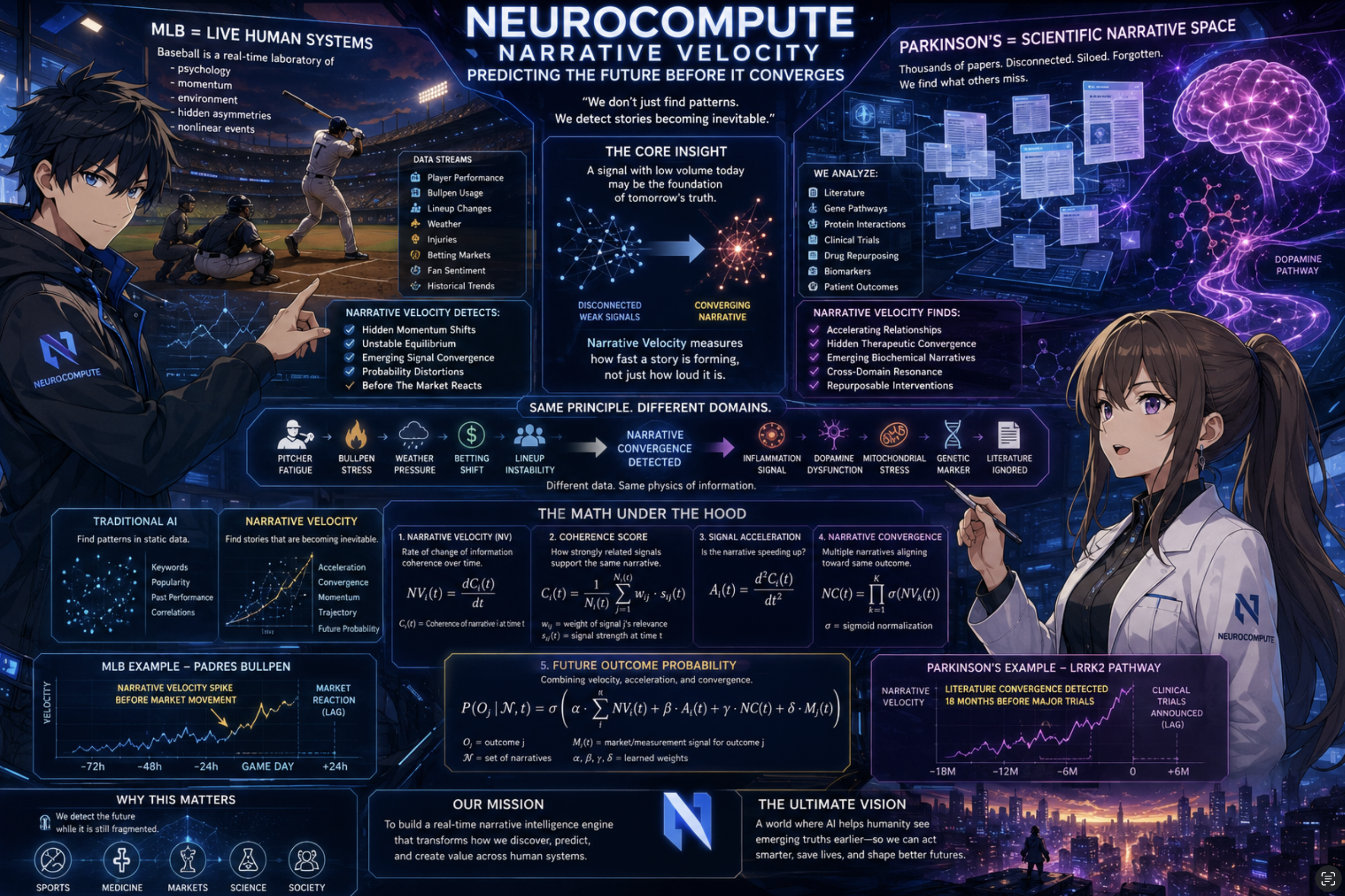
Neurocompute Parkinson’s Narrative Velocity Infographic
NEUROCOMPUTE VISUAL SYSTEM

Open the Narrative Velocity Map

Explore the full Parkinson’s research intelligence diagram.

Expand Intelligence View →
Full Neurocompute Infographic