C grade · PMID 41919452
View analysis →Finding therapies hidden in 1,516 Parkinson’s papers.
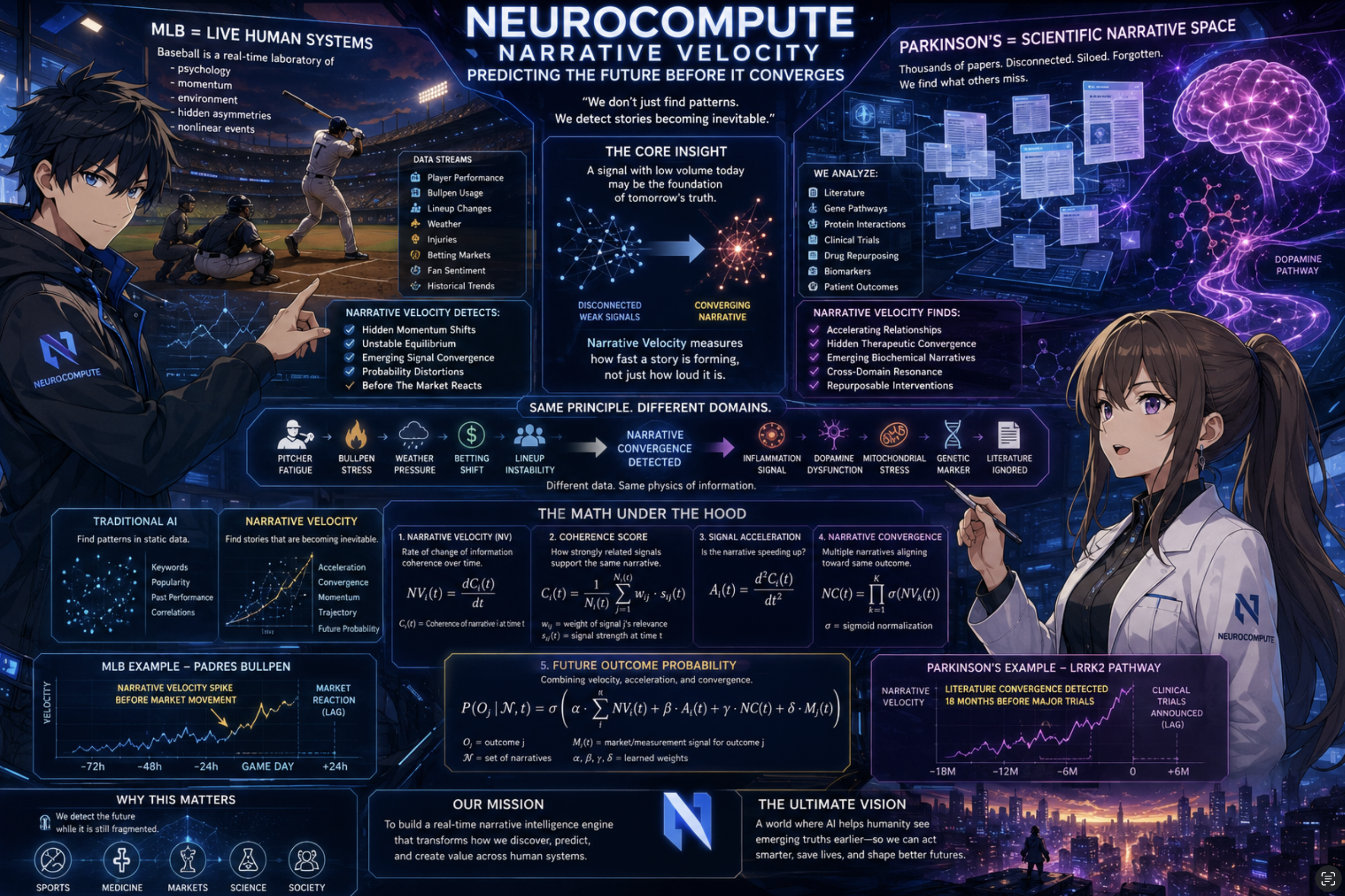
Neurocompute scores biomedical literature, surfaces overlooked patterns, and turns Parkinson’s research into a living discovery terminal.
Ranked discovery teasers
C grade · PMID 42039356
View analysis →C grade · PMID 41902798
View analysis →C grade · PMID 41983917
View analysis →C grade · PMID 42004492
View analysis →C grade · PMID 41916755
View analysis →C grade · PMID 41977502
View analysis →D grade · PMID 41966020
View analysis →D grade · PMID 42043670
View analysis →D grade · PMID 42007507
View analysis →Database feed
All ranked Parkinson’s papers
Narrative review summarizes clinical efficacy, safety, and practical implementation challenges of continuous dopaminergic infusion therapies (CSAI, LCIG, LECIG, LDp/CDp, ND0612) for advanced Parkinson’s disease.
Provides clinically actionable information for developing and optimizing device‑aided symptomatic treatments and access pathways, but offers limited mechanistic or disease‑modifying insight for therapeutic discovery.
The study shows that a PRKAG2 (AMPK γ2) R302Q mutation in patient iPSC-derived cardiomyocytes and mutant mice produces impaired glycolysis, increased mitochondrial content and maximal respiration, glycogen/lipid accumulation, and transcriptional changes in redox/mitochondrial pathways, and that…
Though focused on cardiac disease, the work links AMPK-driven bioenergetic and mitochondrial dysfunction to pathology and demonstrates metformin can reverse those defects, offering indirect mechanistic and repurposing insight for Parkinson's strategies that target AMPK, mitochondrial/metabolic…
Scoping review finds dopaminergic treatment—particularly dopamine agonists pramipexole and ropinirole—commonly provokes impulsive-compulsive behaviors in PD (15–35% prevalence), with risk factors including younger age and male sex, and management mainly via tapering or stopping agonists.
Clinically useful for therapeutic decision-making and risk mitigation in PD (monitoring, prescribing choices, and need for alternative strategies), but provides limited mechanistic or biomarker insights to directly drive novel drug discovery.
Analysis of 29 English-language YouTube videos on Parkinson's exercise content found that videos explaining exercise rationale and dosage scored higher on quality and reliability metrics, while guideline-based clinical features did not predict viewer engagement.
While this study has low direct value for therapeutic discovery, it identifies gaps in patient-facing exercise guidance that are important for improving dissemination, adherence to rehabilitation protocols, and ultimately the implementation of evidence-based nonpharmacologic interventions.
Describes a Theiler's murine encephalomyelitis virus (TMEV) infection in C57BL/6J mice that produces neuroinflammation and dopaminergic neuron loss in the substantia nigra as a non-toxin model of Parkinson-like pathology.
Offers a translationally relevant, infection-driven platform to study inflammation-mediated PD mechanisms and to test anti-inflammatory/antiviral or neuroprotective interventions, though its value hinges on how well it reproduces key PD features (e.g., alpha-synuclein aggregation, progressive…
A human KLOTHO KL-VS variant associates with preserved executive function in PD, and elevating klotho in α-synuclein mouse and cellular models improves cognition and synaptic plasticity, lowers α-synuclein levels, rescues NMDAR (GluN2B)-dependent signaling, and enhances microglial uptake of…
This paper nominates klotho as a mechanistically supported, targetable modifier of PD-related cognitive decline (with a genetic biomarker KL-VS) by linking α-synuclein clearance, synaptic/NMDAR modulation, and microglial activity—making klotho-based therapies and biomarker-guided strategies…
This medicinal chemistry study reports RBG derivatives and identifies compound 2-5c as a more potent Nrf2 activator (EC50 4.18 µM) that is neuroprotective in MPP+-treated BV2 cells and rescues motor deficits in MPTP mice.
Presents a tangible preclinical lead — a small-molecule Nrf2 activator with in vitro and in vivo efficacy in PD models — that targets oxidative stress/neuroinflammation and merits further PK, safety, and translational evaluation.
This study shows paraquat induces microglia-driven neuroinflammation that drives pro-inflammatory astrocyte polarization and dopaminergic neuron loss, effects that are reversed by microglial depletion or activation of the PI3K/AKT pathway.
By implicating PI3K/AKT-dependent microglia–astrocyte crosstalk in toxin-induced dopaminergic degeneration, the work points to a targetable inflammatory mechanism (and potential PI3K-modulating interventions) relevant to PD therapeutic development.
Intranasal curcumin reduced anxio-depressive behaviors, oxidative stress, and downregulated NF-κB/NLRP3 inflammasome signaling in a rotenone-induced rat model of Parkinson's disease.
Supports targeting NLRP3/NF-κB-driven neuroinflammation and oxidative stress as therapeutically relevant mechanisms in PD and highlights intranasal curcumin as a potentially translational repurposing/delivery strategy, though the study lacks motor, dopaminergic neuron, and pharmacokinetic endpoints.
Using an MPTP mouse model, diffusion kurtosis imaging and 1H-MRS identified region-specific increases in diffusivity and alterations in Glu/Gln/NAA/Tau ratios that correlated with neuronal loss, gliosis, and dopaminergic degeneration at 24–72 hours post-treatment.
The paper validates sensitive, noninvasive imaging biomarkers for detecting and tracking PD-like microstructural and neurochemical changes in vivo, useful for preclinical therapeutic monitoring and translational biomarker development despite offering limited new mechanistic or targetable insights.
Large observational study of 2,116 Italian PD patients found overall BMI similar to the general population but with sex-specific differences: women had lower BMI, received higher levodopa dosage per kg, and exhibited more dyskinesia, and BMI correlated with levodopa dose and complications.
Although not mechanistic, these clinically relevant findings support personalized levodopa dosing and integrated nutritional management to mitigate motor complications and inform clinical trial stratification and therapeutic optimization.
This FDG- and DAT-PET study in 270 MSA patients identifies distinct metabolic patterns for MSA-P (hypermetabolism in pons/cerebellar posterior lobe/pallidum and hypometabolism in putamen/parieto‑occipital areas) and MSA-C (cerebellar and putaminal hypometabolism), shows greater striatal DAT loss in…
The work provides clinically relevant, subtype-specific imaging biomarkers of metabolism and DAT loss that can improve diagnostic stratification, patient selection and progression tracking in synucleinopathy trials—useful for translational studies though it does not directly identify targetable…
A pilot randomized single-center trial (n=80) found that a nurse-led, Theory of Symptom Management–based home program reduced sialorrhea severity and improved self-management in Parkinson's patients after four weeks compared with control.
This study provides pragmatic, scalable evidence for improving a bothersome PD non-motor symptom and quality of life through behavioral/nursing care, but offers limited mechanistic or drug-discovery insights for therapeutic development.
Large UK primary-care cohort (2007–2021) found declining age-standardized PD incidence but rising PD prevalence, increased vascular parkinsonism diagnoses since 2010, and stable drug-induced parkinsonism, with rates rising with age and generally higher in males.
While it offers little mechanistic or biomarker insight for therapy discovery, the paper is useful for therapeutic planning and trial design by clarifying evolving disease burden, subtype shifts (notably vascular parkinsonism), and demographic patterns that affect recruitment and resource…
Randomized controlled trial protocol testing a 3-week cane-training program versus a time/attention-controlled stretching and education program to evaluate effects on gait speed, mobility, freezing, falls-related outcomes, and satisfaction in people with Parkinson’s disease.
May yield practical, low-cost evidence to guide cane prescription and improve mobility in PD patients, but offers limited mechanistic insight or direct therapeutic discovery value for disease-modifying strategies.
Large multi-centre analyses of 11,243 individuals show that social apathy is a coherent and separable symptom dimension across health, psychiatric, and neurocognitive disorders, including Parkinson's disease.
Although it offers no molecular targets, this robust phenotyping can improve PD trial endpoints, patient stratification, and the design of behavioral or circuit-targeted interventions focused on social motivation.
Engineered exosomes (NEXOGFLG-P1) carrying a GRP94-targeting ligand and a cathepsin-B-cleavable autophagy-targeting peptide cross the BBB, home to substantia nigra neurons in MPTP mice, release the degrader intracellularly, and reduce α-synuclein aggregates via autophagy-lysosomal degradation.
This work demonstrates a translational, targeted delivery platform that overcomes BBB, cell-specificity, and controlled-release barriers for α-synuclein degraders—addressing key obstacles for disease-modifying Parkinson's therapies, though efficacy and safety require further validation in…
In A53T/PFF mice, sleep deprivation selectively upregulates astrocytic LAG3, which disrupts AQP4 polarization and glymphatic α-synuclein clearance to worsen motor deficits and neurodegeneration, and astrocyte-specific AAV-mediated LAG3 knockdown restores clearance and attenuates pathology.
Points to astrocytic LAG3 as an actionable, potentially repurposable target that links sleep loss to α-syn accumulation and PD progression, offering a translational avenue for patients with sleep disturbances pending human validation and safety assessment.
The paper identifies IRF7 as a mitochondria-related gene upregulated in Parkinson's disease that correlates with ferroptosis and immune changes, is downregulated by physical exercise, and in vitro modulates lipid ROS, ATP, mitochondrial morphology, and ferroptosis-related genes.
Points to IRF7 as a putative biomarker and actionable nexus linking mitochondrial dysfunction, ferroptosis, and exercise-mediated neuroprotection in PD—offering a novel target for therapeutic development though requiring in vivo and translational validation.
In a biomarker-defined cohort of PSG-confirmed iRBD participants positive for CSF α-synuclein seed amplification, investigators observed multi-domain prodromal Lewy body disease features (cognitive deficits, subthreshold parkinsonism, neuropsychiatric, autonomic, and sensory symptoms) at…
Defining prodromal synucleinopathy with CSF α-synuclein SAA provides a clinically and biologically specific cohort for early intervention trials, improving patient selection, stratification, and potential outcome measures for Parkinson's and DLB therapeutic development.