AI-POWERED RESEARCH INTELLIGENCE

Finding therapies hidden in 1,516 Parkinson’s papers.

Neurocompute scores biomedical literature, surfaces overlooked patterns, and turns Parkinson’s research into a living discovery terminal.

1,516Papers indexed
984Papers AI scored
998Ranked papers
0.7%Coverage
LIVE RESEARCH INTELLIGENCE
↑ Narrative velocity rising ↑ New papers ingested ↑ Cross-paper convergence detected ↑ AI score dials updating ↑ Research blind spots surfacing
TOP SIGNALS TODAY

Ranked discovery teasers

View all discoveries →
RESEARCH TERMINAL

All ranked Parkinson’s papers

1516 results
AI Summary

MRI study of young Metropolitan Mexico City residents links high PM2.5/ultrafine particle exposure to widespread cortical, subcortical, and cerebellar atrophy with mild cognitive impairment and prior autopsy data show accumulation of amyloid-β, p-tau, alpha-synuclein and TDP-43.

Why It Matters

Provides epidemiologic and in vivo imaging evidence that air pollution is associated with early PD-relevant pathology (alpha-synuclein) and cognitive decline, pointing to a modifiable environmental risk and the need for biomarker development and prevention strategies despite limited direct…

C
Cytoskeletal disintegration in cardiovascular disease-related neurodegeneration.
PMID 41904002 Published: 2026-01-01 Ingested: 2026-04-28 08:58 PM Advances in protein chemistry and structural biology
AI68.0
Base67.2
Rank64.6
AI Summary

Review argues that cardiovascular disease–related hypoperfusion and oxidative stress drive cytoskeletal and microtubule disintegration across neurodegenerative disorders and highlights alpha-synuclein-mediated impairment of microtubule polymerization in substantia nigra dopaminergic neurons…

Why It Matters

Identifies a heart–brain axis and actionable mechanisms (microtubule destabilization, oxidative stress, vascular dysfunction, and proteinopathies) that point to potential therapeutic strategies and biomarkers such as microtubule stabilizers, antioxidant/vascular interventions, and cytoskeletal…

C
Medicinal Chemistry Review of the NEET Protein Family.
PMID 41932344 Published: 2026-04-14 Ingested: 2026-04-28 08:58 PM ChemMedChem
AI78.0
Base66.6
Rank64.1
AI Summary

Medicinal chemistry review of the NEET protein family (mitoNEET/CISD1, CISD2, CISD3) and small‑molecule ligands that modulate their redox‑active [2Fe‑2S] clusters and roles in mitochondrial bioenergetics, mitophagy, and iron metabolism.

Why It Matters

Because mitochondrial dysfunction, defective mitophagy, and iron dysregulation are central to Parkinson's pathogenesis, the review's focus on druggable NEET proteins and existing ligand chemistry (including pioglitazone off‑target engagement) provides a tangible translational path and repurposing…

C
ATP13A2 Loss of Function-Driven Polyamine Dysregulation Induces SAM Depletion and Epigenetic Astrocyte Toxicity.
PMID 41993310 Published: 2026-04-06 Ingested: 2026-04-28 08:58 PM bioRxiv : the preprint server for biology
AI87.0
Base66.5
Rank64.0
AI Summary

ATP13A2 loss in astrocytes depletes cytosolic polyamines, diverting SAM into de novo polyamine synthesis which drives epigenetic reprogramming to a neuroinflammatory, neuron-toxic state; genetic and pharmacologic inhibition of SAM utilization in polyamine biosynthesis prevents this reprogramming…

Why It Matters

Reveals a targetable metabolic–epigenetic axis (polyamine biosynthesis/SAM use) linking lysosomal dysfunction to neurotoxic inflammation with demonstrated pharmacologic rescue, creating clear translational and repurposing opportunities for Parkinson's therapeutic development.

C
O-GlcNAcylation regulates microglial neuroinflammation in Parkinson's disease.
PMID 41904146 Published: 2026-03-28 Ingested: 2026-04-28 08:58 PM NPJ Parkinson's disease
AI78.0
Base66.5
Rank64.0
AI Summary

This study shows decreased O-GlcNAcylation in PD substantia nigra and demonstrates that pharmacological elevation of O-GlcNAcylation (glucosamine or Thiamet-G) in LPS-induced mice and primary microglia preserves dopaminergic neurons, improves motor outcomes, and suppresses microglial NF-κB–driven…

Why It Matters

Identifies O-GlcNAcylation as a druggable metabolic regulator of microglial inflammation with repurposing potential (glucosamine/OGA inhibitors) for neuroprotective, anti-inflammatory PD therapies, though validation in alpha‑synuclein models and human studies is still needed.

C
Mitochondrial Dysfunction in the Inflammatory Process of Neurodegenerative Diseases.
PMID 41898328 Published: 2026-03-16 Ingested: 2026-04-28 08:58 PM Biomedicines
AI78.0
Base66.5
Rank64.0
AI Summary

Comprehensive review linking Complex I/CoQ-driven ETC dysfunction and supercomplex remodeling to elevated ROS, mtDNA/mtDAMP release, and activation of NLRP3, cGAS-STING, and TLR9 inflammatory pathways, and proposing therapeutic approaches such as ETC support, supercomplex stabilization, and…

Why It Matters

Highlights mechanistic, druggable targets and biomarker opportunities directly relevant to Parkinson’s disease—offering actionable paths for repurposing, neuroprotective interventions, and translational studies that bridge mitochondrial dysfunction and neuroinflammation.

C
Repurposing of doxycycline as a novel therapeutic avenue for management of parkinson's disease.
PMID 41925933 Published: 2026-04-02 Ingested: 2026-04-28 08:58 PM Inflammopharmacology
AI70.0
Base66.4
Rank63.9
AI Summary

This review surveys preclinical and mechanistic literature suggesting doxycycline’s antioxidant, anti-inflammatory, and ER-stress–modulating activities may protect dopaminergic neurons and thus could be repurposed for Parkinson’s disease.

Why It Matters

Repurposing an FDA-approved drug with demonstrated neuroprotective effects offers a comparatively fast translational path for PD therapeutics targeting inflammation, oxidative and ER stress, but concrete molecular mechanisms and clinical efficacy data are still limited.

AI Summary

This systematic review/meta-analysis of 54 human studies finds both F2-isoprostanes and 8-OHdG markedly elevated in T2DM, but only 8-OHdG is moderately elevated in Parkinson's disease, indicating DNA oxidative damage rather than lipid peroxidation may better reflect oxidative stress in PD and…

Why It Matters

Identifies 8-OHdG as a more promising biomarker for PD patient stratification and target‑engagement in trials and argues for standardized, multi-compartment and longitudinal biomarker studies to de-risk antioxidant-focused therapeutic development.

C
Disulfidptosis in Neurodegenerative Diseases: From Redox Imbalance to Neuronal Dysfunction.
PMID 42031063 Published: 2026-04-22 Ingested: 2026-04-28 08:58 PM Behavioural brain research
AI61.0
Base66.3
Rank63.9
AI Summary

This review hypothesizes that disulfidptosis—a disulfide-stress-driven, cytoskeletal-collapse form of regulated cell death—may contribute to neurodegenerative diseases including Parkinson's, but evidence is mainly indirect and lacks direct validation in neural systems.

Why It Matters

By linking redox imbalance, metabolism, mitochondrial dysfunction, and cytoskeletal collapse, the paper highlights a mechanistically plausible pathway that could reveal new therapeutic targets or biomarkers for Parkinson's if followed by experimental validation in relevant neuronal and glial models.

C
Decode the Ubiquitinome in Parkinson's Disease: From Pathological Aggregates to Targeted DUB Therapeutics.
PMID 41902877 Published: 2026-03-28 Ingested: 2026-04-28 08:58 PM Neuroscience bulletin
AI80.0
Base66.1
Rank63.7
AI Summary

Comprehensive review mapping ubiquitination dynamics and DUB roles in PD pathogenesis, linking DUB-mediated stabilization of α-synuclein and suppression of mitophagy to therapeutic opportunities with small-molecule DUB inhibitors.

Why It Matters

Highlights druggable deubiquitinating enzymes that can be targeted to restore proteostasis and mitochondrial quality control, providing actionable avenues for developing disease‑modifying Parkinson's therapies.

C
The central role of mitochondrial dysfunction in neurodegeneration: implications for therapy.
PMID 42043769 Published: 2026-04-27 Ingested: 2026-04-28 08:58 PM Molecular and cellular biochemistry
AI76.0
Base66.0
Rank63.6
AI Summary

This focused review synthesizes how mitochondrial defects (bioenergetics, calcium handling, dynamics, mitophagy, ROS and mtDNA-mediated inflammation) drive neurodegeneration and evaluates mitochondria-targeted therapies—from antioxidants and mitochondrial transfer to lifestyle and…

Why It Matters

Highly relevant to Parkinson's therapeutic discovery because it consolidates actionable mitochondrial mechanisms and intervention strategies, highlights disease-stage and patient-heterogeneity issues, and therefore serves as a practical roadmap for prioritizing target-specific interventions and…

C
[18F]Fluorodeoxyglucose positron emission tomography ([18F]FDG PET) Characterizes Neurodegeneration Levels Across the α-Synucleinopathy Continuum.
PMID 41937449 Published: 2026-04-05 Ingested: 2026-04-28 08:58 PM Movement disorders : official journal of the Movement Disorder Society
AI72.0
Base66.0
Rank63.6
AI Summary

This study demonstrates that [18F]FDG PET disease-related metabolic patterns and regional analyses can distinguish prodromal iRBD, converters, PD, and DLB and track progressive neurodegeneration across the α‑synucleinopathy continuum, with strongest performance in cognitive‑predominant…

Why It Matters

Offers a clinically translatable biomarker for patient stratification, progression monitoring, and trial endpoints—particularly for dementia‑first synucleinopathies—enabling better selection of participants and mechanism‑linked outcome measures in therapeutic development.

C
Four weeks of supervised home-based aerobic cycling improves cardiopulmonary function in patients with Parkinson's disease.
PMID 41908277 Published: 2026-01-01 Ingested: 2026-04-28 08:58 PM Frontiers in neurology
AI40.0
Base66.0
Rank63.6
AI Summary

A 4-week supervised home-based aerobic cycling program (3×/week at 70–80% heart rate reserve) significantly improved maximal power output, VO2peak, anaerobic threshold, and peak expiratory flow in 17 mild-to-moderate PD patients.

Why It Matters

Shows a feasible, remotely supervised intervention that meaningfully boosts cardiopulmonary fitness and functional capacity in PD patients—valuable for symptomatic management and trial design—but provides limited mechanistic or disease-modifying therapeutic insights.

C
Acupuncture: A Promising Non-Pharmacological Approach to Parkinson's Disease Management.
PMID 42021550 Published: 2026-04-01 Ingested: 2026-04-28 08:58 PM Brain and behavior
AI74.0
Base65.7
Rank63.3
AI Summary

Preclinical studies indicate acupuncture exerts multi-modal neuroprotective effects in PD models—upregulating Nrf2 antioxidant defenses, modulating autophagy/alpha‑synuclein clearance, suppressing apoptosis/pyroptosis and neuroinflammation, promoting neurogenesis via BDNF/GDNF, and altering gut…

Why It Matters

Highlights multiple disease-relevant and potentially druggable pathways (Nrf2, autophagy/lysosome, NLRP3, neurotrophic signaling, gut–brain axis) that could inform therapeutic discovery, while being limited by predominantly preventive preclinical data and heterogeneity that hinder immediate…

C
Glial Plasticity and Dysfunction: Mechanistic Insights and Therapeutic Opportunities in Neurodegeneration.
PMID 41906403 Published: 2026-04-01 Ingested: 2026-04-28 08:58 PM Journal of neurochemistry
AI74.0
Base65.7
Rank63.3
AI Summary

This review synthesizes recent advances in glial heterogeneity and plasticity—covering metabolic dysfunction, inflammatory polarization, glial-immune crosstalk, and extracellular vesicle signaling—and evaluates glia-focused interventions (reprogramming, senolytics, engineered EVs, metabolic…

Why It Matters

By highlighting actionable glial mechanisms that drive neuroinflammation and metabolic failure and surveying translatable interventions and delivery/biomarker challenges, the paper identifies promising, though still preclinical, avenues to target glia for disease-modifying Parkinson's therapies.

C
Research progress on employing medicinal plants and their active compounds to target autophagic pathways for Parkinson's disease therapy.
PMID 41895540 Published: 2026-06-28 Ingested: 2026-04-28 08:58 PM Journal of ethnopharmacology
AI62.0
Base65.7
Rank63.3
AI Summary

Systematic review of medicinal plants and their active compounds that target autophagy in Parkinson's disease, summarizing preclinical evidence for multi-target neuroprotective effects while noting limited mechanistic validation and a lack of rigorous clinical trials.

Why It Matters

Emphasizes autophagy modulation and related anti-inflammatory/antioxidant mechanisms as promising translational avenues and flags specific gaps—target specificity, toxicity, standardization, and need for mechanistic and clinical validation—that are critical for prioritizing plant-derived leads for…

C
Plant-derived soft electrophiles upregulate pro-resolving oxylipins in a paraquat-induced Drosophila model of Parkinson's disease.
PMID 41929085 Published: 2026-03-27 Ingested: 2026-04-28 08:58 PM bioRxiv : the preprint server for biology
AI75.0
Base65.3
Rank63.0
AI Summary

In a paraquat-induced Drosophila PD model the authors developed an oxylipin quantification method and show that specific lipophilic plant-derived soft electrophiles (certain flavones and related phytochemicals) increase pro-resolving oxylipins in fly heads via the NF-κB orthologue relish, with sex-…

Why It Matters

Provides a mechanistic, actionable route—dietary soft electrophiles that boost SPM/oxylipin biosynthesis—to resolve neuroinflammation linked to PD risk, making identifiable compounds and pathways ready for mammalian validation and therapeutic development.

C
AI74.0
Base64.7
Rank62.5
AI Summary

This review synthesizes mechanisms and translational strategies for controlled blood–brain barrier modulation (e.g., receptor-mediated transcytosis, ligand-engineered nanocarriers, focused ultrasound, viral/molecular engineering) to improve delivery of neuroprotective, anti-α-synuclein, and…

Why It Matters

By detailing clinically actionable BBB delivery platforms, safety considerations, and biomarker-directed approaches, the paper addresses a key translational bottleneck for Parkinson’s therapeutics—enabling targeted brain delivery of α-synuclein-targeting and neuroprotective agents that could…

AI Summary

In a small controlled study (n=28) an 8-week supervised combined aerobic-resistance program improved tremor subscore and 6-minute walk distance in people with PD while exploratory labs showed a decrease in vitamin D3 that remained significant after FDR correction.

Why It Matters

Findings support short-term symptomatic benefit of structured exercise and suggest metabolic signals worth follow-up, but the study's small size, short duration and lack of mechanistic data limit its direct value for drug discovery or target identification.

C
Potential crosstalk between Parkinson's disease and glucose metabolism.
PMID 41947366 Published: 2026-04-25 Ingested: 2026-04-28 08:58 PM Journal of biomedical research
AI74.0
Base64.3
Rank62.2
AI Summary

This review synthesizes evidence that impaired brain glucose metabolism — including altered glycolysis and disrupted neuron–astrocyte metabolic coupling driven by dopamine, alpha-synuclein, and DJ-1 dysfunction — contributes to PD and evaluates strategies to restore glycolytic/energetic homeostasis.

Why It Matters

By linking specific molecular drivers to metabolic deficits and assessing glycolysis-targeted and repurposing strategies, the paper highlights actionable therapeutic avenues with translational potential to slow Parkinson's disease progression.

Previous
Page 6 of 76
Next
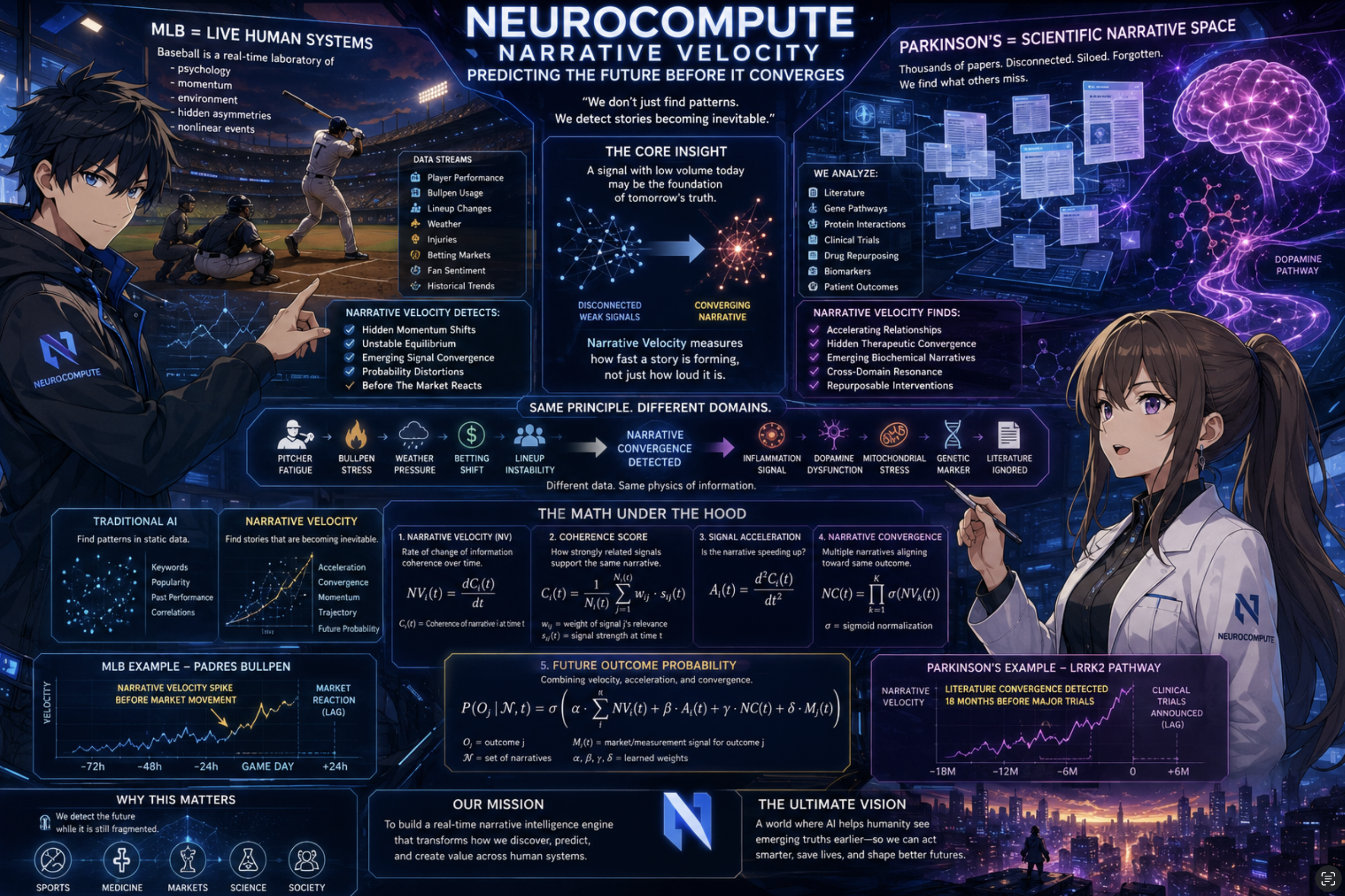
Neurocompute Parkinson’s Narrative Velocity Infographic
NEUROCOMPUTE VISUAL SYSTEM

Open the Narrative Velocity Map

Explore the full Parkinson’s research intelligence diagram.

Expand Intelligence View →
Full Neurocompute Infographic