C grade · PMID 42040397
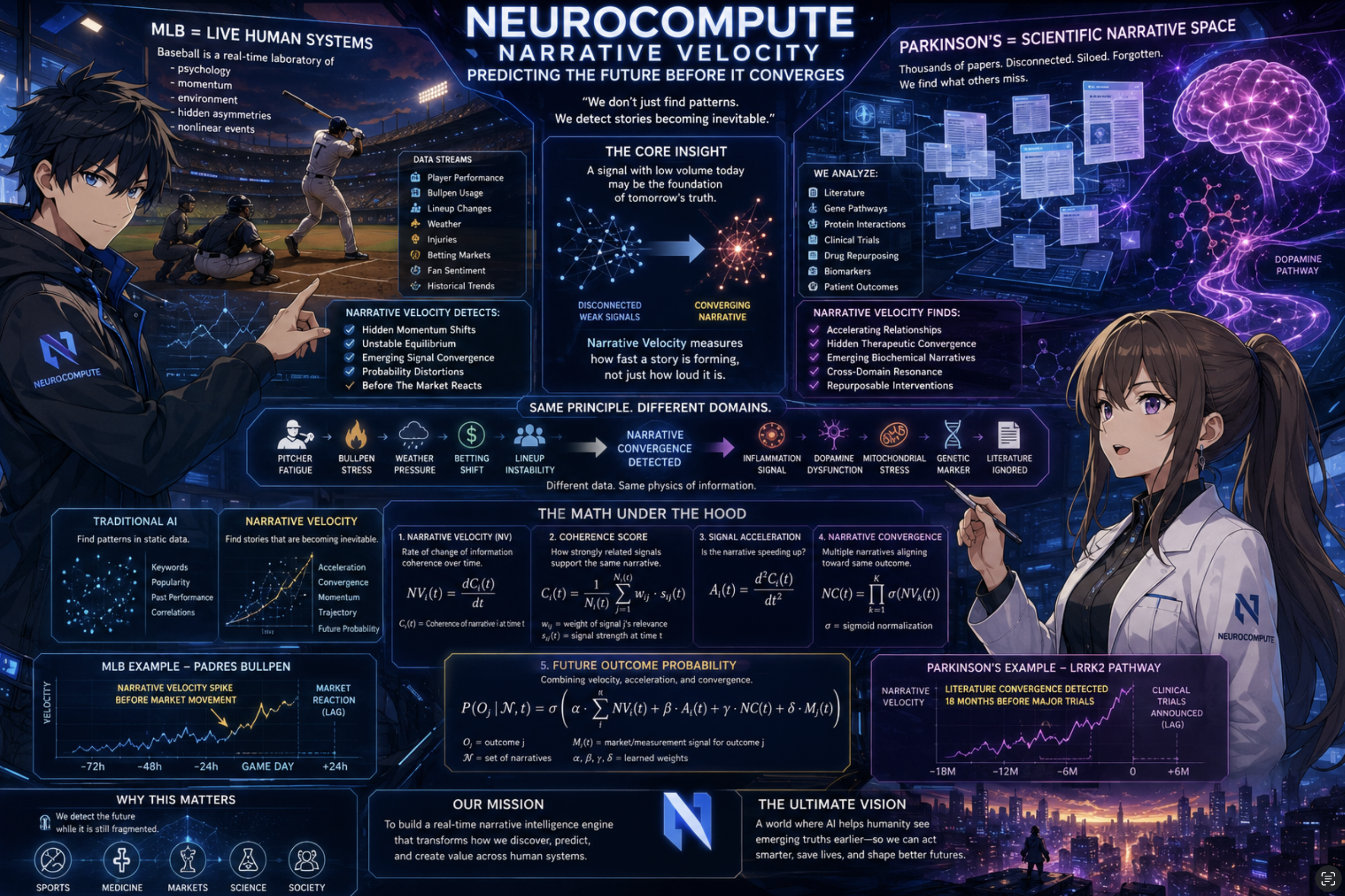
View analysis →Finding therapies hidden in 1,516 Parkinson’s papers.
Neurocompute scores biomedical literature, surfaces overlooked patterns, and turns Parkinson’s research into a living discovery terminal.
Ranked discovery teasers
C grade · PMID 42023271
View analysis →C grade · PMID 42028419
View analysis →C grade · PMID 42046408
View analysis →C grade · PMID 42015463
View analysis →C grade · PMID 42000098
View analysis →C grade · PMID 42003184
View analysis →C grade · PMID 41932887
View analysis →C grade · PMID 41936814
View analysis →C grade · PMID 42002934
View analysis →Database feed
All ranked Parkinson’s papers
This is a broad review cataloging plant-derived peptides with reported neuroprotective actions—attenuating oxidative stress and inflammation, preserving mitochondria, modulating apoptosis and inhibiting toxic protein aggregation—but it is not Parkinson's-specific and notes BBB/bioavailability and…
The review highlights multiple mechanisms (mitochondrial protection, anti-inflammatory effects, aggregation inhibition) that are directly relevant to Parkinson's therapeutic targets and provides a useful source of peptide leads for follow-up PD-focused validation and optimization despite…
This review reframes Parkinson's as a lifelong neurobiological trajectory in which early-life epigenetic, neuroimmune, and mitochondrial insults increase dopaminergic vulnerability and argues for prevention via lifestyle, enrichment, and public-health measures.
Highlights actionable mechanistic pathways (epigenetics, neuroinflammation, mitochondrial dysfunction) that can guide biomarker development and early-intervention or prevention studies, though it offers limited direct, short-term therapeutic candidates.
Narrative review synthesizing animal and clinical evidence to map molecular mechanisms of memory impairment in Parkinson's disease, emphasizing dopamine depletion, alpha-synuclein pathology, neuroinflammation, oxidative stress, cholinergic dysfunction, impaired synaptic plasticity, cortical…
Useful for therapeutic discovery because it consolidates multiple actionable target areas (inflammation, alpha‑synuclein, cholinergic and synaptic mechanisms, gut–brain interactions) to guide prioritization and repurposing, though its narrative review format and lack of novel data limit immediate…
Comprehensive review of diabetes-related cerebral microvascular structural and functional abnormalities and their links to neurological diseases, including a section discussing implications for Parkinson's disease and potential microcirculation-targeted interventions.
By synthesizing mechanisms like BBB disruption, neurovascular uncoupling, inflammation and therapeutic approaches (lifestyle, glucose-lowering, vasoprotective strategies), the paper highlights indirectly actionable vascular and metabolic targets that could be explored to modulate vascular…
Post-hoc multicenter longitudinal case-control study found safinamide 100 mg reduced weight-adjusted levodopa dose and total LEDD more in women than men over ~9 months, while improving motor scores and reducing OFF time in both sexes.
Shows a clinically actionable, sex-specific levodopa-sparing effect for an approved MAO-B inhibitor that could guide personalized adjunctive therapy to reduce dyskinesia risk and should be tested prospectively.
A translational review arguing that motivation and effort arise from interactions between dopamine and multiple other neuromodulators (adenosine, GABA, serotonin, norepinephrine, acetylcholine) and metabolic signals, explaining persistent apathy/anhedonia in Parkinson's and recommending…
Highlights non-dopaminergic contributors and potential repurposable targets for PD-related apathy/anhedonia, supporting biomarker-driven patient stratification and development of targeted symptomatic therapies when dopaminergic treatment is insufficient.
This paper describes IP-045, a novel small-molecule chemical chaperone that inhibits alpha-synuclein aggregation in vitro, reduces oxidative and ER stress in cell models, and improves motor, cognitive, and neuropathological outcomes in a rotenone rat model of Parkinson's disease.
By directly targeting alpha-synuclein aggregation while also mitigating oxidative/ER stress and inflammation, IP-045 represents a translationally promising multi-target lead for disease-modifying PD therapies, although further pharmacokinetic, safety, and mechanistic validation is required.
This study shows TMBIM6 protects dopaminergic neurons by binding and inhibiting IRE1α—loss of TMBIM6 exacerbates α‑synuclein/rotenone toxicity and IRE1α activation, while TMBIM6 overexpression or pharmacologic/genetic IRE1α inhibition is neuroprotective across cellular, Drosophila, and mouse PD…
Defines a druggable TMBIM6–IRE1α axis with mechanistic, human tissue, pharmacologic, and gene‑therapy evidence, providing a translational target and potential biomarker pathway for neuroprotective therapies in Parkinson’s disease.
In a haloperidol-induced rat PD model, oral valsartan improved motor behavior, preserved nigral dopaminergic markers (TH, DAT, D2, ALDH1A1), increased ASCL1/Nurr1 expression, modulated epigenetic regulators (↓HDAC1/5, ↑SIRT1), and reduced α-synuclein, with Nurr1 blockade attenuating its benefits.
Because valsartan is an approved, brain‑penetrant drug showing multimodal, disease‑modifying signals (Nurr1 activation, epigenetic modulation, α‑syn reduction) that support repurposing for PD, though findings need replication in toxin/genetic neurodegeneration models and translational studies.
This preclinical study shows that formononetin, a phytoestrogen, alleviates MPP+/MPTP-induced neurotoxicity and motor deficits by activating the SIRT1/PGC-1α/NRF1/TFAM axis to restore mitochondrial biogenesis, reduce ROS, and preserve mitochondrial integrity in SH-SY5Y cells and MPTP mice.
By providing in vitro and in vivo evidence that a small natural compound can pharmacologically restore mitochondrial biogenesis and function via a defined SIRT1/PGC-1α pathway, the study offers an actionable therapeutic lead and biomarker axis for PD drug discovery, while translation will require…
This study identifies a previously unrecognized dopaminergic projection from the locus coeruleus to the retrosplenial cortex that controls short-term declarative memory and is functionally compromised in Parkinson's model mice, with optogenetic and chemogenetic manipulations demonstrating causal…
By defining a specific neuromodulatory circuit linked to early cognitive deficits in PD, the work points to projection-targeted neuromodulation or dopamine-focused interventions as actionable strategies for treating non-motor symptoms and guiding translational therapeutic development.
In an acute MPTP mouse model, 14-day intraperitoneal chrysoeriol (5 mg/kg) treatment improved motor and cognitive behaviors, reduced neuronal damage and alpha-synuclein levels, improved the Bcl-2/Bax ratio, and implicated PI3K/Akt-mediated mitochondrial protection.
This study offers preclinical, mechanism-linked evidence that a small-molecule flavone can attenuate alpha-synuclein–associated apoptosis and functional deficits in vivo, making chrysoeriol a promising lead for further pharmacokinetic, dose-ranging, chronic and alpha-synucleinopathy-model…
Computational network pharmacology, docking, and 100-ns molecular dynamics indicate methoxylated flavonoids—notably Eupatilin—bind multiple PD-relevant targets (HSP90AA1, MMP9, GSK-3β, AKT1) and modulate PI3K-Akt signaling with favorable predicted ADMET.
Provides a prioritized, drug-like multi-target lead and mechanistic hypotheses in PD that justify targeted in vitro and in vivo validation toward potential disease-modifying therapies.
This review synthesizes evidence that astrocytes and microglia actively shape dopaminergic signaling, neuroinflammation, metabolism, and behavior and proposes a translational framework to target glial states to restore dopamine homeostasis in disorders including Parkinson's disease.
By framing glia as actionable modulators of dopamine circuits and integrating multi-omics, in vivo imaging, and computational approaches, the paper highlights non-neuronal therapeutic targets and biomarker strategies (inflammation, metabolism, glial states) that could be leveraged for…
This study shows that upregulated FICD-mediated AMPylation in dopaminergic neurons drives lysosomal dysfunction, ER stress, reduced protein turnover and α-synuclein aggregation across human post-mortem tissue, patient iPSC-derived neurons, and synucleinopathy models, and that pharmacological…
It identifies FICD as a druggable, mechanistic regulator of proteostasis linking AMPylation to lysosomal and α-synuclein pathology, with multi-model preclinical pharmacological rescue that makes it a high-priority therapeutic target for Parkinson's disease discovery.
GBA1 mutations drive upregulation of LCN2 across multiple in vivo and in vitro models, and LCN2 promotes α-synuclein accumulation, oxidative stress, and dopaminergic neuron loss while genetic deletion or antibody intervention mitigates these effects.
This provides strong preclinical target validation of LCN2 as a druggable downstream mediator linking GBA1-related lysosomal dysfunction to inflammation, ROS and α-syn pathology, offering a clear translational path for antibody/small-molecule therapies or biomarker development in GBA1-associated…
This study identifies biallelic PSMF1 (hPI31) variants causing a spectrum from early-onset parkinsonism to perinatal lethality, links these variants to altered proteasome assembly and mitochondrial dysfunction in patient cells, and shows age-dependent motor deficits and dopaminergic…
By genetically implicating PSMF1/hPI31 and connecting proteasomal dysregulation to mitochondrial and mitophagy defects, the paper provides a validated mechanistic pathway, patient cellular phenotypes, and animal models that highlight proteasome regulation and mitochondrial quality control as…
In MPTP-treated mice and astrocyte cultures, inhibition of S100A9 with paquinimod reversed senescence markers, reduced SASP factors, restored mitochondrial biogenesis gene expression and TH-positive fibers, and improved motor behavior, while recombinant S100A9 induced senescence-like and…
Provides a druggable link between aging-related cellular senescence, mitochondrial dysfunction, and dopaminergic neurodegeneration in PD, highlighting paquinimod repurposing potential and a clear target for follow-up translational studies.
Using DAT-SPECT and the SuStaIn algorithm in 636 drug‑naive PD patients, the study identifies three reproducible nigrostriatal degeneration subtypes with distinct clinical features, CSF α‑synuclein seeding associations, and differential longitudinal treatment responses.
Offers an imaging‑based, clinically actionable stratification that can improve trial enrichment and patient selection, predict differential motor and neuropsychiatric outcomes after therapy, and link phenotype to α‑synuclein biology to inform biomarker‑driven therapeutic strategies.
In a 6-OHDA rat model of levodopa-induced dyskinesia, striatal ATG14 overexpression enhanced SNARE-dependent autophagosome-lysosome fusion, promoted ΔFosB degradation, and reduced dyskinesia, effects that were blocked by the autophagy inhibitor chloroquine.
This work pinpoints ATG14/SNARE-driven autophagy as a mechanistic and actionable target to mitigate LID, offering a translational route for developing autophagy-enhancing or gene-based interventions to treat dyskinesia in Parkinson's disease patients.