← Back to all signals
RESEARCH PAPER ANALYSIS

Integrative network pharmacology delineates dual GPCR and non-GPCR mechanisms of blended and individual Taikong Blue lavender and Pingyin rose essential oils in neurodegenerative and psychiatric disorders.

This computational network-pharmacology study of lavender and rose essential oils identifies 252 shared protein targets across neuropsychiatric disorders, highlights CHRM2 (muscarinic GPCR) and NR1H3 (LXR) as central hubs, and supports terpenoid binding to these targets via docking, MD, and MM/PBSA…

PMID41985299
JournalComputers in biology and medicine
Publication Date2026-05-15
Ingested2026-04-28 08:58 PM
EXECUTIVE SUMMARY

What the AI sees

This computational network-pharmacology study of lavender and rose essential oils identifies 252 shared protein targets across neuropsychiatric disorders, highlights CHRM2 (muscarinic GPCR) and NR1H3 (LXR) as central hubs, and supports terpenoid binding to these targets via docking, MD, and MM/PBSA…

WHY IT MATTERS

Research significance

Modulation of a druggable GPCR (CHRM2) and a lipid/inflammation regulator (NR1H3) offers plausible, actionable leads for influencing cholinergic dysfunction and neuroinflammation relevant to Parkinson's disease, but the findings are purely in silico and require biochemical and in vivo validation…

ABSTRACT

Source abstract

Neurodegenerative and psychiatric disorders share overlapping molecular mechanisms, including neuroinflammation, oxidative stress, and neurotransmitter dysregulation. Essential oils from Lavandula angustifolia (TLEO) and Rosa rugosa (PREO) contain neuroactive compounds with therapeutic potential, but their mechanisms remain poorly defined. This study aimed to elucidate the shared and distinct molecular targets and pathways of TLEO and PREO using a multi-scale computational strategy. Compounds identified by GC-MS were evaluated through ADMET profiling, target prediction, and disease-target intersection analysis. Enrichment, network, docking, and dynamics analyses were performed on shared protein-coding targets between essential oils and twelve brain disorders, including seven neurodegenerative conditions (Alzheimer's disease, amyotrophic lateral sclerosis, Friedreich ataxia, Huntington's disease, Lewy body disease, Parkinson's disease, spinal muscular atrophy) and five psychiatric disorders (autism spectrum disorder, attention deficit-hyperactivity disorder, bipolar disorder, major depressive disorder, and schizophrenia). A total of 110 compounds yielded 252 common targets, with CHRM2 (GPCR) and NR1H3 (non-GPCR) identified as key hubs. Docking suggested strong binding affinities for caryophyllene oxide at CHRM2 (-7.3 kcal/mol) and α-himachalene at NR1H3 (-8.5 kcal/mol). Molecular dynamics simulations confirmed stable, compact complexes with low RMSD and SASA values. MM/PBSA free energy calculations quantitatively validated these interactions, revealing favorable binding energetics driven predominantly by van der Waals and hydrophobic contributions, consistent with the terpenoid chemical profiles. Functional enrichment highlighted involvement in cholinergic signaling, lipid metabolism, and inflammatory regulation. This study demonstrates that PREO and TLEO can modulate multiple targets relevant to brain disorders through both GPCR and non-GPCR mechanisms. These findings provide a computationally inferred mechanistic framework for the potential neuroprotective synergy of these oils and highlight essential oil-derived compounds as promising leads for further experimental investigation.

SUPPORTING PAPER SET

32 more papers to review

Ranked by current scoring engine
1 The cGAS-STING-Glymphatic-gut Axis in Parkinson's disease: A proposed self-amplifying triad of Neuroinflammation and therapeutic opportunity. International immunopharmacology 91.0 2 Immunosenescence and Inflammaging as Drivers of Neurodegeneration: Cellular Mechanisms, Neuroimmune Crosstalk, and Therapeutic Implications. Cells 91.0 3 Flavonoids improve neurotransmitters for Parkinson's treatment: mechanism and therapeutic potential. Frontiers in pharmacology 88.0 4 Alpha-Lipoic Acid and Biotin in Neurodegenerative Diseases: Convergent Mechanistic Insights from Preclinical Models to Clinical Perspectives. Neurology international 78.0 5 The Gut Microbiota in Parkinson's Disease: Mechanistic Insights into Microbial-Host Interactions. Microorganisms 85.0 6 Linking inflammation, metabolic dysfunction, and neurodegeneration: a comprehensive review of TLR2 pathways in type 2 diabetes. Frontiers in clinical diabetes and healthcare 80.0 7 Neuroprotective effects of GLP-2 and a GLP-2/GIP dual receptor agonist in an MPTP-induced mouse model of Parkinson's disease. Peptides 86.0 8 TNF alpha unmasks enteric malate aspartate shuttle dysfunction bridging Parkinson disease and intestinal inflammation. Nature communications 91.5 9 Lipid Metabolism and Neurodegeneration: Mechanistic Insights and Therapeutic Targets. Ageing research reviews 82.0 10 Shared functional microbiome signatures in Parkinson's disease and constipation predominate irritable bowel syndrome despite taxonomic divergence. Brain, behavior, & immunity - health 80.0 11 Benzimidazole as a Versatile Scaffold for Developing Neurotherapeutics Against Neurodegenerative Diseases. ChemMedChem 74.0 12 Biomimicking neuromelanin reverses the gait deficits and dopaminergic neuronal loss in the Parkinson's disease. Colloids and surfaces. B, Biointerfaces 86.0 13 Neuroprotective roles of klotho: Molecular pathways and therapeutic implications for cognitive health in neurological and psychiatric diseases. Experimental physiology 84.0 14 Flavonoid Rutin Reduces Intestinal Inflammation in an Experimental Model of Parkinson's Disease. Neurotoxicity research 70.0 15 Nanostructured Lipid Carriers Enhance Brain Delivery and Antioxidant Efficacy of a Small-Molecule MAO B Inhibitor for Neurodegenerative Disease Therapy. Molecular pharmaceutics 78.0 16 Pathophysiological Role of the Gut Brain Axis in Parkinson's Disease: From Microbial Metabolites and Intestinal Permeability to Central Neuroinflammation. Current neurovascular research 86.0 17 Parkinson's Disease: From Metabolism to Genetics-A Comprehensive Review. Current issues in molecular biology 86.0 18 Navigating the cholesterol maze: Key insights on use of statins in neurodegenerative disorders. Neuroprotection (Chichester, England) 76.0 19 Models of neuroprotection in Parkinson's disease: Exploring cellular, molecular, and microenvironmental targets. Experimental neurology 78.0 20 Hyaluronic acid: emerging roles and biomaterial innovations in Alzheimer's and Parkinson's disease therapy. Frontiers in pharmacology 75.2 21 Molecular mechanisms underlying Parkinson's disease and role of phytochemicals, α-synuclein, sirtuins, and incretin mimetics in potential therapy. Frontiers in pharmacology 75.0 22 Lipid droplets in neurodegenerative diseases: pathological drivers and therapeutic vulnerabilities. Cell death discovery 82.0 23 Brain-gut-microbiota axis: a review on the bidirectional regulatory mechanisms between gut microbiota and brain and their disease interactions. Frontiers in microbiology 74.0 24 Long non-coding RNAs in neurodegenerative diseases - Molecular mechanisms, liquid biopsy biomarkers, and therapeutic targets: A review. Biomolecules & biomedicine 84.0 25 Neurosyphilis and Parkinsonism: Overlapping Pathophysiology and Emerging Therapeutic Insights. Current neurovascular research 76.0 26 Molecular biochemistry of soluble epoxide hydrolase in lipid mediator pathways and neuroinflammatory responses. The Journal of steroid biochemistry and molecular biology 82.0 27 Multifaceted role of CNPY2 beyond ER stress: Disease implications and therapeutic potential. Cell stress 83.3 28 Neuroprotective Role of Exercise-based Physiotherapy Combined with Pharmacological Agents in Parkinson's Disease. Central nervous system agents in medicinal chemistry 64.0 29 Distinct metabolomic and proteomic signatures in Parkinson's disease patients with REM sleep behavior disorder. Signal transduction and targeted therapy 84.0 30 HMGB1-mediated neuroinflammation: molecular mechanisms and emerging therapeutic approaches. Inflammopharmacology 78.0 31 Beyond acid-base dyshomeostasis: Dynamic instability of neuronal lysosomal pH as a pathogenic mechanism and therapeutic target in neurological diseases. Biochemical pharmacology 88.0 32 Vitamins as Modulators of Neurodegenerative Disease Pathways: Mechanisms and Therapeutic Perspectives. Nutrients 74.0
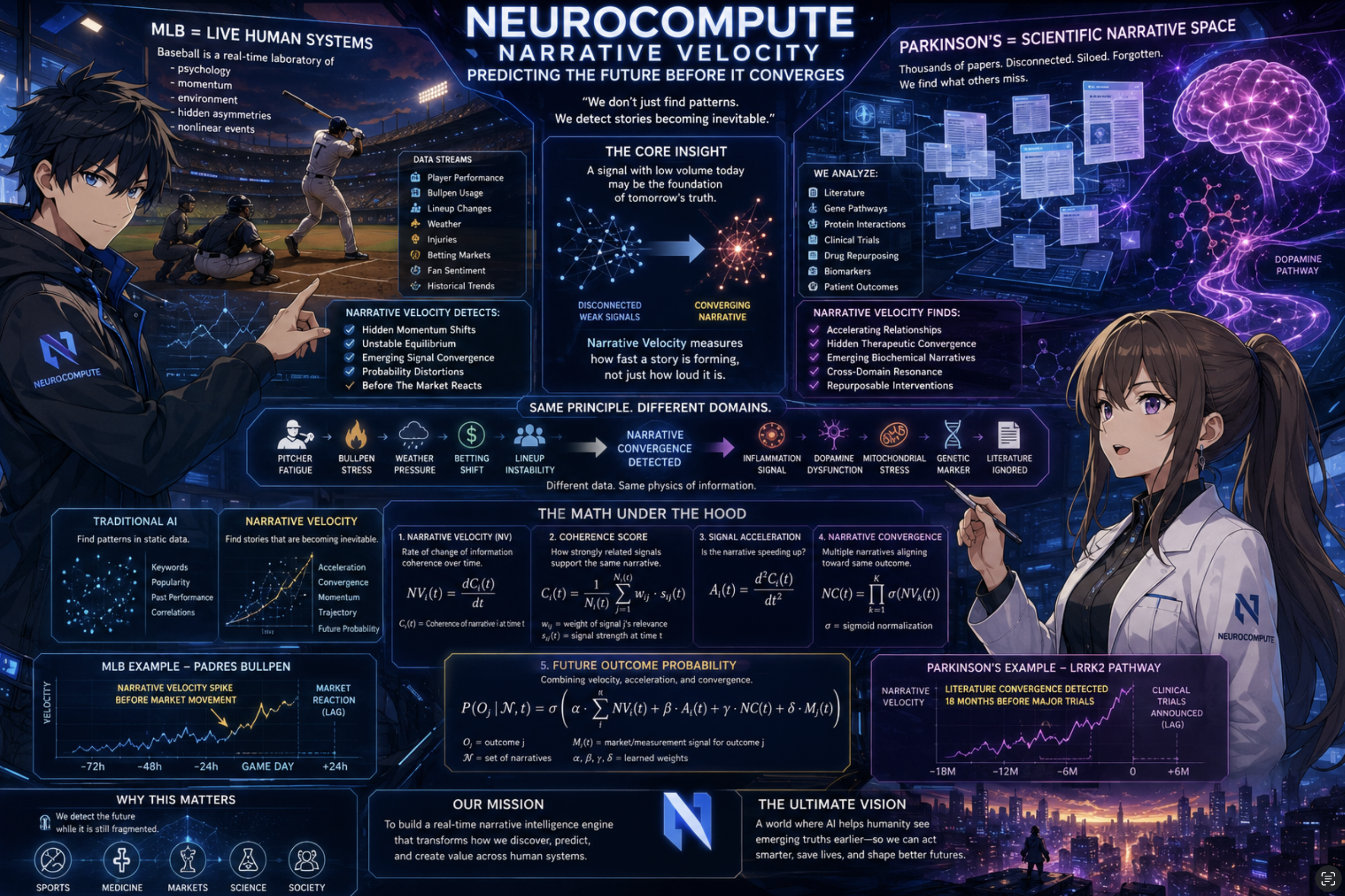
Neurocompute Parkinson’s Narrative Velocity Infographic
NEUROCOMPUTE VISUAL SYSTEM

Open the Narrative Velocity Map

Explore the full Parkinson’s research intelligence diagram.

Expand Intelligence View →
Full Neurocompute Infographic