C grade · PMID 42034029
View analysis →Finding therapies hidden in 1,516 Parkinson’s papers.
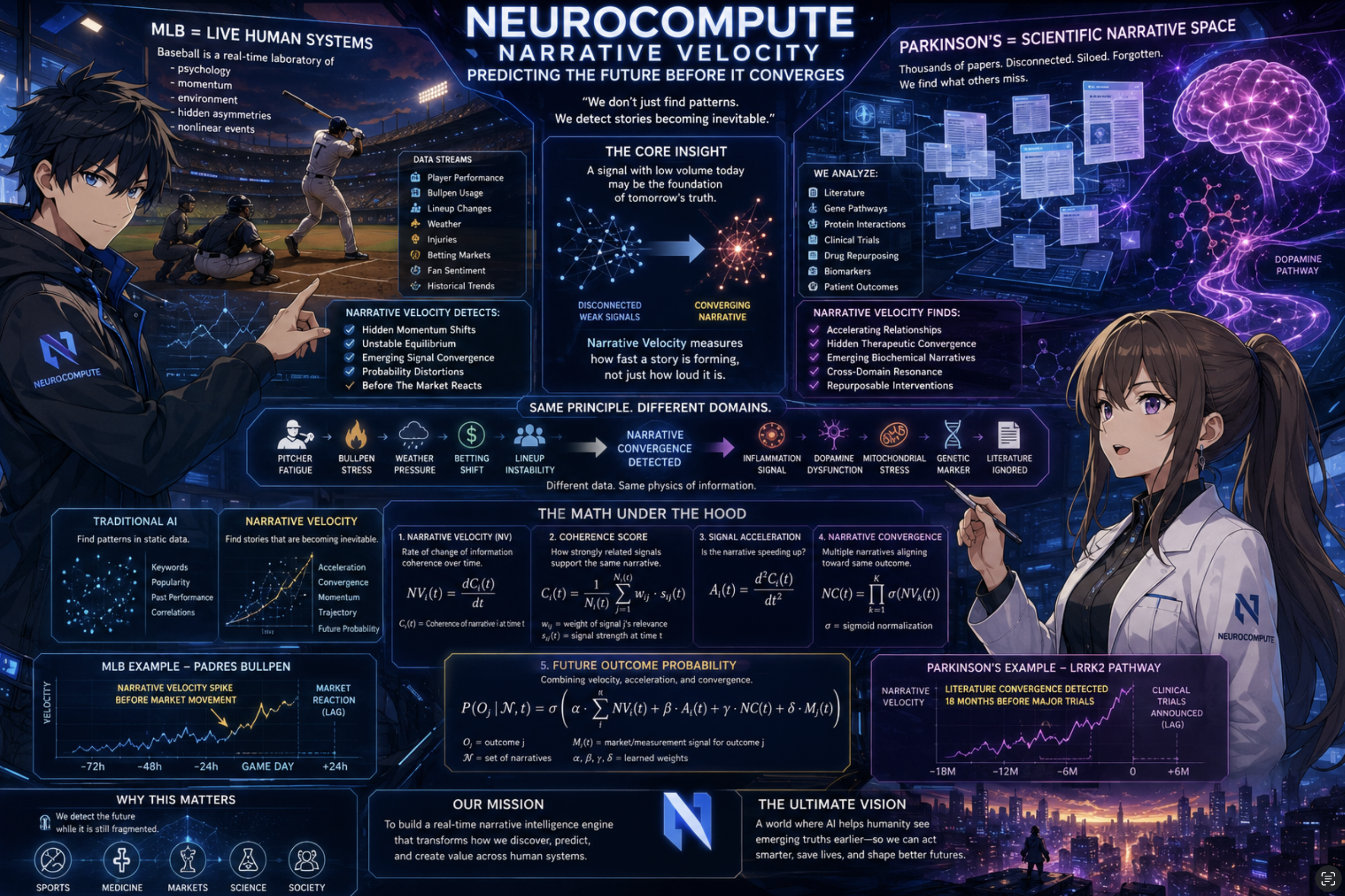
Neurocompute scores biomedical literature, surfaces overlooked patterns, and turns Parkinson’s research into a living discovery terminal.
Ranked discovery teasers
C grade · PMID 42039828
View analysis →C grade · PMID 41975607
View analysis →C grade · PMID 41998308
View analysis →C grade · PMID 42009995
View analysis →C grade · PMID 41898669
View analysis →C grade · PMID 41969957
View analysis →C grade · PMID 41931118
View analysis →C grade · PMID 42016530
View analysis →C grade · PMID 41913885
View analysis →Database feed
All ranked Parkinson’s papers
In MPTP mice, the Chinese medicine formula Da-Bu-Yin-Wan + Qian-Zheng-San (BYQZF) ameliorates motor and non-motor deficits, reduces α-syn aggregation and dopaminergic neuron loss by reshaping gut microbiota (enriching Lachnospiraceae/Ruminococcaceae), raising serum SCFAs (notably butyrate),…
Offers actionable preclinical mechanistic evidence that modulating gut microbiota or supplementing SCFAs (butyrate) — and targeting the TLR4/MyD88/NF-κB inflammatory axis — may be a viable therapeutic strategy for PD, though the herbal formula's active constituents remain undefined for direct drug…
This review argues that periodontitis-driven oral microbiota dysbiosis can seed the gut and, through systemic inflammation, altered neurotransmitter metabolism, and microbial metabolites (e.g., SCFAs, LPS) affecting the blood–brain barrier, influence brain function and contribute to depression and…
Relevance to Parkinson's lies in highlighted, potentially actionable pathways (oral-to-gut microbial translocation, inflammation, BBB and metabolite-mediated neural effects) that could yield novel intervention or biomarker avenues, though the paper is a broad review with limited mechanistic…
In cell and mouse models of Parkinson's disease, HDAC3 inhibition reduced microglial M1 polarization and proinflammatory cytokine production, suppressed pyroptosis via an interaction with HIF‑1α, and preserved nigral dopaminergic neurons with improved behavior.
Pins HDAC3 as an actionable anti‑inflammatory/anti‑pyroptotic target with in vivo neuroprotection, supporting further preclinical development or repurposing of selective HDAC3 inhibitors for PD therapeutics.
Using bioinformatics, single-cell RNA-seq datasets, and validation in A53T α-synuclein transgenic mice, the paper identifies five mitophagy-related hub genes (CANX, GABARAPL1, HSPD1, PPARGC1A, TOMM20) that are differentially expressed across substantia nigra cell types and peripheral immune cells…
By linking validated mitophagy-related genes to both CNS cell-specific and peripheral immune alterations in PD, the study provides actionable candidate targets and biomarkers for mitochondrial-focused therapeutic development and immune-modulating strategies.
This preclinical study finds that tocotrienol-rich fraction (TRF) reduces microglial NO/ROS, downregulates RelA/TNF-α/IL-6 and upregulates NFE2L2 and BDNF, with improved cognition in a rat pilot, indicating anti-inflammatory and antioxidant neuroprotective effects.
Neuroinflammation and oxidative stress are key drivers of Parkinson's pathology, so TRF's modulation of NF-κB and Nrf2 pathways suggests translational repurposing potential, but lack of PD-specific models and dopaminergic/alpha-synuclein data means focused follow-up is needed.
Bauhinia thailandica leaf extract reduced ROS, NO, IL-6, IL-1β, and TNF-α in LPS-activated BV2 microglia and is rich in phenolics, flavonoids, and tannins.
Targeting microglial inflammation and oxidative stress is relevant to Parkinson's disease neuroprotection, but this study is limited to in vitro BV2 assays without mechanism, active compound identification, or PD-relevant models, so the findings are promising but preliminary for therapeutic…
In a 12-week prospective cohort of 35 PD patients, intermittent subcutaneous apomorphine markedly improved motor function, reduced daily "off" time, and produced significant gains in depression, cognition, and quality-of-life measures, with consistent effects across age groups.
While not addressing disease modification, the study provides actionable clinical evidence that apomorphine confers broad symptomatic benefits—including non-motor domains—supporting its use, informing endpoint selection for trials, and guiding symptomatic therapeutic strategies despite limited…
This broad review synthesizes evidence that gut microbiota dysbiosis and gut-derived metabolites (SCFAs, bile acids, TMAO, LPS) drive systemic inflammation and neurodegeneration via gut‑brain axis signalling and barrier dysfunction, and surveys microbiome-targeted interventions (diet, probiotics,…
For Parkinson's research, the paper highlights actionable pathways linking the microbiome to neuroinflammation and potentially alpha-synuclein pathology and points to readily testable therapeutic and biomarker strategies (dietary modulation, probiotics/FMT, metabolite-targeting drugs) that can be…
Longitudinal analysis of 159 early-stage PD patients shows daytime sleepiness increases over time independent of levodopa (notably in patients >65), while fatigue increases are associated with levodopa dose escalation (primarily in patients ≤65).
Distinguishing disease-driven daytime sleepiness from medication-associated fatigue highlights modifiable targets for symptomatic management and informs therapeutic development and trial stratification for PD non-motor symptoms.
Prospective, single-center study of 114 idiopathic PD patients found orthostatic hypotension in 28% (detected by head-up tilt testing), with prevalence rising sharply with disease duration and Hoehn & Yahr stage and including asymptomatic cases.
The paper has moderate translational value: it supports routine HUTT screening to prevent falls and to stratify or monitor patients for symptomatic autonomic therapies and clinical trials, but offers limited mechanistic or novel therapeutic-target insights for disease-modifying drug discovery.
A mechanistic review linking alpha-synuclein, mitochondrial and lysosomal dysfunction to NLRP3 inflammasome activation in PD and summarizing plant natural products that modulate NLRP3 as candidate neuroprotective agents.
Identifies a druggable, inflammation-driven axis (NLRP3) closely tied to core PD pathologies and compiles plant-derived modulators with translational promise, making it a useful roadmap for prioritizing leads and designing preclinical studies.
Comprehensive review linking α-synuclein aggregation, mitochondrial dysfunction, oxidative stress, neuroinflammation, and peripheral-central communication to current and emerging PD therapies—covering symptomatic pharmacotherapy, α-syn-targeted immunotherapies, iPSC-based regenerative approaches,…
Synthesizes actionable mechanistic insights and translational therapeutic avenues (immunotherapy, cell replacement, gene therapy), helping researchers prioritize targets, repurposing opportunities, and design of multi-modal, clinically relevant Parkinson’s interventions.
Comprehensive review of mesenchymal stem cell (MSC) therapy in Parkinson’s disease that synthesizes preclinical mechanisms (immunomodulation, neurotrophic factors, exosomes/proteostasis), early-phase clinical safety/feasibility and symptomatic signals, and key translational challenges (dosing,…
Valuable for therapeutic discovery because it links biologically plausible, inflammation- and proteostasis-targeting mechanisms to early clinical data and clearly identifies manufacturability, potency, and biomarker gaps that must be resolved to enable rigorous disease-modifying MSC trials.
This review frames stem cell therapies for Parkinson's disease along a regenerative–restorative continuum, distinguishing intracerebral dopaminergic-replacement approaches (fetal/ESC/iPSC) from paracrine/immunomodulatory restorative strategies (MSCs and others) and integrating mechanistic links to…
By clarifying how cell type and delivery route map onto distinct mechanisms and clinical goals, the framework aids prioritization of translational strategies, trial design, and selection of biomarkers for PD disease-modifying therapy development.
Comprehensive review arguing that TAAR1 modulates dopamine, serotonin, and noradrenaline signaling via effects on transporters and VMAT2 and collates preclinical/clinical data positioning TAAR1 as a druggable target in neurodegeneration and psychiatric disease.
Highlights TAAR1 as a translationally actionable target to rebalance monoaminergic systems and potentially slow Parkinson's pathology, offering a clear therapeutic focus despite limited direct coverage of PD-specific mechanisms like alpha‑synuclein or mitochondrial dysfunction.
This review links dysregulated neuroinflammation and autophagy (via mTOR/AMPK, inflammasomes, chaperone-mediated autophagy and impaired clearance of α-synuclein) to neurodegeneration and surveys therapeutic strategies—mTOR inhibitors, autophagy enhancers, inflammasome modulators, gene/RNA editing,…
Relevant to Parkinson’s therapeutic discovery because it consolidates actionable targets and translational approaches (autophagy pathways, inflammasome/CMA modulation, biomarkers, gene/RNA therapies, and screening technologies) that can guide target selection and repurposing, although its value is…
This narrative review (2020–2025) compiles preclinical and limited clinical evidence that rosemary and its main constituents (rosmarinic, carnosic, ursolic acids) exert antioxidant, anti‑inflammatory, mitochondrial‑stabilizing, autophagy‑promoting and neurotransmitter‑modulating effects relevant to…
It identifies PD‑relevant mechanisms (Nrf2 activation, NF‑κB inhibition, BDNF modulation, enhanced autophagic clearance, mitochondrial protection, and reduced protein aggregation) that support further lead optimization and translational work, but its utility is limited by being a narrative review…
A large propensity-matched EHR study finds that systemic autoimmune diseases broadly increase cerebrovascular risk (TIA, ischemic stroke) and show a more variable, disease-dependent association with incident Parkinson's and Alzheimer's disease; systemic corticosteroids had limited impact on…
This paper signals that systemic inflammation and vascular comorbidity are important stratifiers and potential modifiable risk axes for PD research—supporting vascular surveillance, cohort stratification, and targeted mechanistic work on inflammation–vascular interactions rather than immediate…
The paper shows that astrocytic FABP5 is upregulated in MSA and, upon uptake of α-synuclein PFFs, drives TNFα-dependent inflammation and ferroptotic lipid peroxidation that depletes GPX3 and causes non-cell-autonomous oligodendrocyte death, while Fabp5 silencing rescues oligodendrocytes.
Although centered on MSA, the study defines an actionable astrocyte-mediated pathway (FABP5 → TNFα → ferroptosis/GPX3 loss) linking α-synuclein pathology to glial-driven degeneration, highlighting targets and modalities (FABP5 inhibition, TNF modulation, ferroptosis/GPX3-directed therapies) with…
This integrated GWAS–metabolomics study shows Alzheimer’s and Parkinson’s disease have distinct metabolic-genetic architectures, with PD-associated shared loci enriched for mitochondrial function, vesicle trafficking, and stress-response signaling while many causal metabolite links were seen for AD.
The PD-specific enrichment for mitochondrial, vesicle-trafficking, and stress-response pathways yields actionable mechanistic priorities for Parkinson’s therapeutic discovery and argues for genetically informed, metabolism-targeted strategies distinct from those for AD.