← Back to all signals
RESEARCH PAPER ANALYSIS

Autoimmune diseases are associated with increased neurodegenerative and cerebrovascular risk, while systemic corticosteroid exposure shows limited neurodegenerative and modest vascular associations.

A large propensity-matched EHR study finds that systemic autoimmune diseases broadly increase cerebrovascular risk (TIA, ischemic stroke) and show a more variable, disease-dependent association with incident Parkinson's and Alzheimer's disease; systemic corticosteroids had limited impact on…

PMID42021966
JournalIBRO neuroscience reports
Publication Date2026-06-01
Ingested2026-04-28 08:58 PM
EXECUTIVE SUMMARY

What the AI sees

A large propensity-matched EHR study finds that systemic autoimmune diseases broadly increase cerebrovascular risk (TIA, ischemic stroke) and show a more variable, disease-dependent association with incident Parkinson's and Alzheimer's disease; systemic corticosteroids had limited impact on…

WHY IT MATTERS

Research significance

This paper signals that systemic inflammation and vascular comorbidity are important stratifiers and potential modifiable risk axes for PD research—supporting vascular surveillance, cohort stratification, and targeted mechanistic work on inflammation–vascular interactions rather than immediate…

ABSTRACT

Source abstract

Systemic autoimmune diseases (AIDs), characterized by chronic peripheral inflammation and frequent vascular comorbidity, are increasingly linked to adverse central nervous system (CNS) outcomes; however, comparative evidence across diverse AIDs and clarification of the roles of vascular burden, inflammatory activity, and immunomodulatory therapy remain limited. Using the TriNetX Global Collaborative Network, we conducted a sequence of retrospective, propensity score-matched cohort experiments in adults aged 50-85 years to quantify incident Parkinson's disease (PD), Alzheimer's disease (AD), transient ischemic attack (TIA), and ischemic stroke across 22 AIDs and to evaluate therapy- and inflammation-stratified risk patterns. In the primary disease-control analysis (Experiment 1 A), AID diagnosis was associated with broadly elevated neurodegenerative and cerebrovascular risk, with stronger and more consistent associations for TIA and ischemic stroke than for PD and AD. To probe robustness, we repeated analyses under tighter control of baseline vascular burden (Experiment 1B: additional matching on circulatory-system diagnoses) and under treatment balancing (Experiment 1 C: additional matching on immune-suppressant exposure). Vascular matching substantially attenuated many associations, particularly for AD, whereas immune-suppressant matching did not materially erase the pervasive cerebrovascular excess. Within-disease CRP stratification (Experiment 2; low vs elevated CRP) did not yield a uniform neurodegenerative gradient but identified a disease-dependent ischemic vulnerability axis in selected inflammatory phenotypes. In treatment substudies, systemic cortisone exposure (Experiment 3) showed little association with PD/AD risk but a modest, heterogeneous increase in TIA/ischemic stroke. Medication-specific strata (Experiment 4) revealed stronger but directionally variable separations, consistent with confounding by indication and severity. Together, these findings position systemic autoimmunity as a robust marker of heightened cerebrovascular risk and a more phenotype-dependent correlate of neurodegenerative risk, supporting intensified vascular surveillance in high-risk AID populations and mechanistic work disentangling inflammation, comorbidity, and treatment.

SUPPORTING PAPER SET

32 more papers to review

Ranked by current scoring engine
1 The cGAS-STING-Glymphatic-gut Axis in Parkinson's disease: A proposed self-amplifying triad of Neuroinflammation and therapeutic opportunity. International immunopharmacology 91.0 2 Immunosenescence and Inflammaging as Drivers of Neurodegeneration: Cellular Mechanisms, Neuroimmune Crosstalk, and Therapeutic Implications. Cells 91.0 3 Flavonoids improve neurotransmitters for Parkinson's treatment: mechanism and therapeutic potential. Frontiers in pharmacology 88.0 4 Alpha-Lipoic Acid and Biotin in Neurodegenerative Diseases: Convergent Mechanistic Insights from Preclinical Models to Clinical Perspectives. Neurology international 78.0 5 The Gut Microbiota in Parkinson's Disease: Mechanistic Insights into Microbial-Host Interactions. Microorganisms 85.0 6 Linking inflammation, metabolic dysfunction, and neurodegeneration: a comprehensive review of TLR2 pathways in type 2 diabetes. Frontiers in clinical diabetes and healthcare 80.0 7 Neuroprotective effects of GLP-2 and a GLP-2/GIP dual receptor agonist in an MPTP-induced mouse model of Parkinson's disease. Peptides 86.0 8 TNF alpha unmasks enteric malate aspartate shuttle dysfunction bridging Parkinson disease and intestinal inflammation. Nature communications 91.5 9 Lipid Metabolism and Neurodegeneration: Mechanistic Insights and Therapeutic Targets. Ageing research reviews 82.0 10 Shared functional microbiome signatures in Parkinson's disease and constipation predominate irritable bowel syndrome despite taxonomic divergence. Brain, behavior, & immunity - health 80.0 11 Benzimidazole as a Versatile Scaffold for Developing Neurotherapeutics Against Neurodegenerative Diseases. ChemMedChem 74.0 12 Biomimicking neuromelanin reverses the gait deficits and dopaminergic neuronal loss in the Parkinson's disease. Colloids and surfaces. B, Biointerfaces 86.0 13 Neuroprotective roles of klotho: Molecular pathways and therapeutic implications for cognitive health in neurological and psychiatric diseases. Experimental physiology 84.0 14 Flavonoid Rutin Reduces Intestinal Inflammation in an Experimental Model of Parkinson's Disease. Neurotoxicity research 70.0 15 Nanostructured Lipid Carriers Enhance Brain Delivery and Antioxidant Efficacy of a Small-Molecule MAO B Inhibitor for Neurodegenerative Disease Therapy. Molecular pharmaceutics 78.0 16 Pathophysiological Role of the Gut Brain Axis in Parkinson's Disease: From Microbial Metabolites and Intestinal Permeability to Central Neuroinflammation. Current neurovascular research 86.0 17 Parkinson's Disease: From Metabolism to Genetics-A Comprehensive Review. Current issues in molecular biology 86.0 18 Navigating the cholesterol maze: Key insights on use of statins in neurodegenerative disorders. Neuroprotection (Chichester, England) 76.0 19 Integrative network pharmacology delineates dual GPCR and non-GPCR mechanisms of blended and individual Taikong Blue lavender and Pingyin rose essential oils in neurodegenerative and psychiatric disorders. Computers in biology and medicine 65.0 20 Models of neuroprotection in Parkinson's disease: Exploring cellular, molecular, and microenvironmental targets. Experimental neurology 78.0 21 Hyaluronic acid: emerging roles and biomaterial innovations in Alzheimer's and Parkinson's disease therapy. Frontiers in pharmacology 75.2 22 Molecular mechanisms underlying Parkinson's disease and role of phytochemicals, α-synuclein, sirtuins, and incretin mimetics in potential therapy. Frontiers in pharmacology 75.0 23 Lipid droplets in neurodegenerative diseases: pathological drivers and therapeutic vulnerabilities. Cell death discovery 82.0 24 Brain-gut-microbiota axis: a review on the bidirectional regulatory mechanisms between gut microbiota and brain and their disease interactions. Frontiers in microbiology 74.0 25 Long non-coding RNAs in neurodegenerative diseases - Molecular mechanisms, liquid biopsy biomarkers, and therapeutic targets: A review. Biomolecules & biomedicine 84.0 26 Neurosyphilis and Parkinsonism: Overlapping Pathophysiology and Emerging Therapeutic Insights. Current neurovascular research 76.0 27 Molecular biochemistry of soluble epoxide hydrolase in lipid mediator pathways and neuroinflammatory responses. The Journal of steroid biochemistry and molecular biology 82.0 28 Multifaceted role of CNPY2 beyond ER stress: Disease implications and therapeutic potential. Cell stress 83.3 29 Neuroprotective Role of Exercise-based Physiotherapy Combined with Pharmacological Agents in Parkinson's Disease. Central nervous system agents in medicinal chemistry 64.0 30 Distinct metabolomic and proteomic signatures in Parkinson's disease patients with REM sleep behavior disorder. Signal transduction and targeted therapy 84.0 31 HMGB1-mediated neuroinflammation: molecular mechanisms and emerging therapeutic approaches. Inflammopharmacology 78.0 32 Beyond acid-base dyshomeostasis: Dynamic instability of neuronal lysosomal pH as a pathogenic mechanism and therapeutic target in neurological diseases. Biochemical pharmacology 88.0
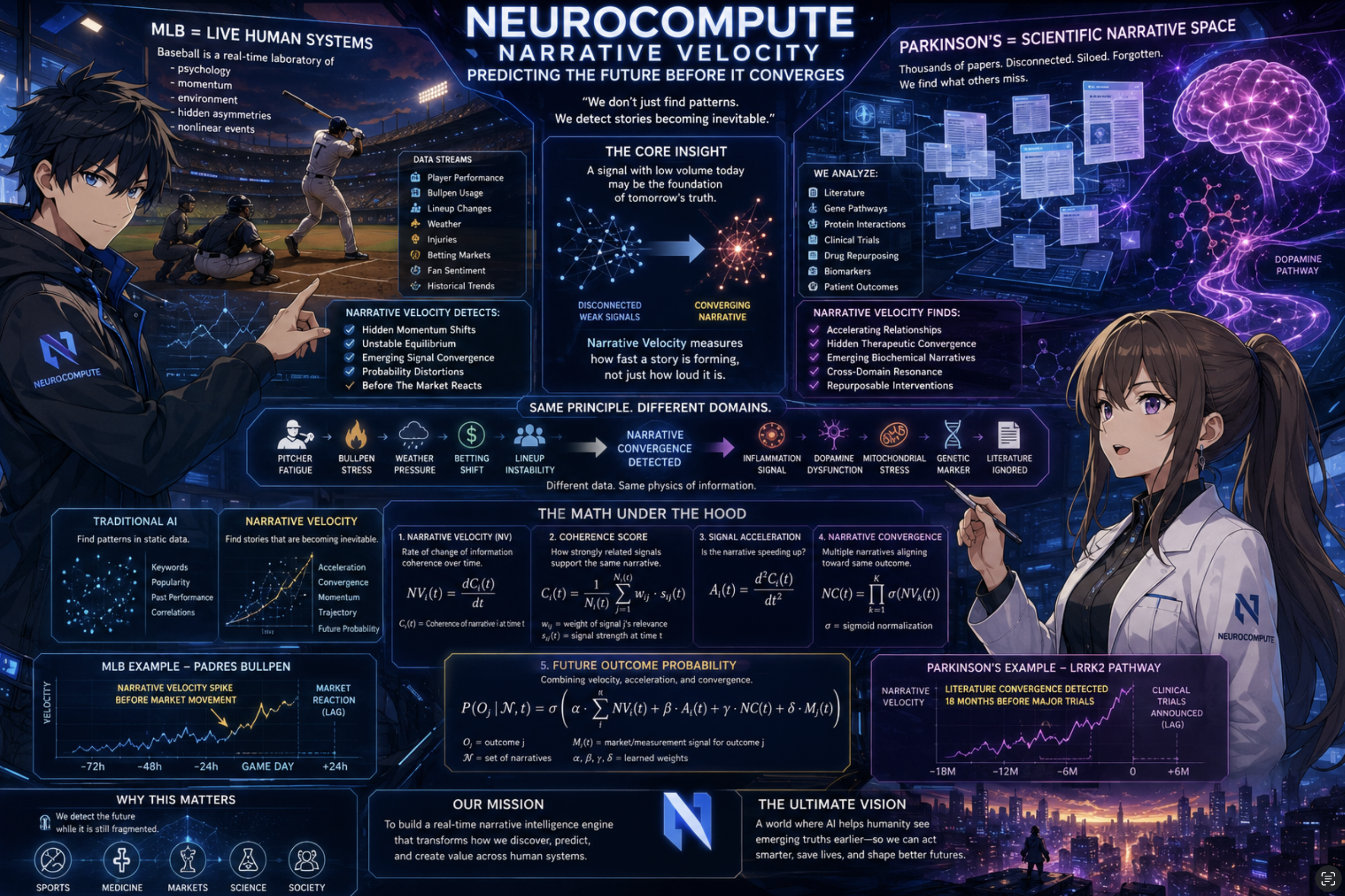
Neurocompute Parkinson’s Narrative Velocity Infographic
NEUROCOMPUTE VISUAL SYSTEM

Open the Narrative Velocity Map

Explore the full Parkinson’s research intelligence diagram.

Expand Intelligence View →
Full Neurocompute Infographic